Thursday, February 20, 2014

Why Migratory Birds Ignore Puxsutawney Phil

I for one am tired of the cold. Don't get me wrong, this winter in Delaware has been great. We've had an abundance of snow and few days of freezing rain, but this Texans had enough. I was raised on a steady diet of 6 months of hot, 2 months of cold, and 4 months that are only kind of hot. By mid February it's time to start buying swimsuits and stocking up on suntan lotion.

Punxsutawney Phil the Perpetrator
  (Alessandro M.)
Unfortunately, I don't live in Texas anymore. Punxsutawney Phil, the infallible weather muse, has predicted six more weeks of winter for the east coast. We'll forget for a second that our rodent friend is less than stellar at prediction and take his words at furry face value.

Just 2 weeks from now, the lucky residents in Texas will herald their first of the season main land migrants, and in 3 weeks every gulf state from Texas to Florida will see their very first migratory species. This may sound early to some of you, and indeed it is, but certain individuals in a population will try to get an early start to their breeding season. These include the southern breeding species like the Golden-cheeked Warbler, southern U.S wintering warblers like the Northern Parula , the early gulf migrant Louisiana Waterthrush, and the seemingly always migrating Purple Martin.


This winter has been brutally cold. We've seen record snowfalls in the south, and the great lakes ice coverage at it's highest extent since 1994 (90%). If this years weather and our furry friends ominous prediction is right, these early birds will be in a heap of trouble. So why would an individual migrate early when its still cold and how do birds cope with the wildly inconsistent weather in spring?

The extent of the ice on the great lakes this year (noaa.gov)
Lets start of first with an easy question:
----------------------------------
Why even show up early?
----------------------------------
Birds benefit from arriving early in a variety of ways. They get the best pick of territories, avoid predators, and have more chances to succeeded. All of this equates to better breeding success (the chance of successfully raising chicks to adulthood).

Males arriving to a breeding site first get the best pick of territories. If these males choose the highest quality habitat, they'll have an easier time feeding their nestlings. This increases not only an individual chicks chance of surviving, but increases the numbers of chicks a pair can raise.

Common predators for nesting songbirds include snakes and raptors (birds of prey). The time of the highest nest predation coincides with the middle of the breeding season. Nesting hawks have to forage more as their own nestlings grow up. This increases predation as the seasons progresses. With the progression of seasons, temperatures heat up, leading to more snake species migrating out of their winter dens. This all culminates in peak nest predation in the middle of the breeding season. Earlier migrants can skip this dangerous phase by nesting earlier before these factors peak.

Most songbirds nest multiple times in a season until they finally succeed. Some crazier birds may even renest after they've succeeded in raising the first nest.  In the case of Willow Flycatchers, some parents begin nesting before the first brood is even able to fly! So, with an early start to the breeding season, you get not only more chances to succeed, but more time to raise even more young!

It's clear, there's a real advantage to showing up as early as you can.
----------------------------------
What could possibly go wrong?
----------------------------------
Well mainly weather.
The top weather-related killer of birds is the cold. Untimely snow storms routinely kill birds who aren't prepared. Particularly wet snow can quickly saturate a birds feathers, forcing it to land freezing and wet. Situations like this kill even hardy snow birds. It's no surprise that species who aren't used to cold temperatures regularly die of exposure when an unseasonal cold front penetrates into the south [1].

Ice can also be particularly tricky for birds. Waterbirds, like ducks, require open water to feed. When all available water is frozen over, many starve before they can find water. Because of this, ducks often fly hundreds of miles south in search of open water in the winter. This permanent relocation leaves many of us in the Northern States (yah I just said that Auriel) with a lack of ducks for the rest of winter.

Surf Scoters, Indian River inlet, DE
Birds who usually experience extreme weather are well adapted to it. It's when temperate birds run into this weather that there becomes a problem. These birds spend the majority of their time in warmer locations and tremendous amounts of energy flying thousands of miles north to breed. These exhausted tropical vacationers are ill suited in maintaining their internal temperatures. In spring, spending a night below 10 degrees Celsius (50F) costs a songbird the same energy as flying for 3 hours. [2]. To a small song bird that's ~90 miles! [3].

----------------------------------
So what keeps them from showing up early?
---------------------------------- 
The range map of Golden-Winged Warblers
Migratory birds react strongly to temperature. The correlation between the average temperature at a migrants wintering grounds and summer grounds is both fascinating and complicated (We'll go indepth on this at a later date). Many studies have shown some species won't migrate north unless it's certain temperature.[2][4] Unseasonably cold temperatures in spring are usually brought about by a cold front from the north. This all but guarantees the northern latitudes are also cold. Migrants can dictate their future weather patterns by monitoring temperatures and delaying their departure till situations improve.

The pattern of migration is generally where southern migrants move through first and northern populations arrive later.  This keeps migrating birds at a manageable latitude, but can lead to highly incongruous breeding seasons. A warbler breeding in the southern Appalachian Mountains in late April has entire month head start over it's twin breeding all the way in Canada in June.


Despite evolutionary traits, some birds still fly straight into bad weather.

Last year, a late arctic blast ran straight through the Midwest. Migrating rails, already on their journey, were faced with frozen wetlands with no where to go. Lucky for them, these hardy wetlands species have adaptations to survive in conditions similar to this. Rail species like the Virginia and Clapper rail are routinely found all the way into Delaware and New Jersey in winter. The northern most breeding rail, the Yellow Rail, breeds just shy of the arctic circle. Their bigger bodies, water resistant feathers, and terrestrial foraging allows them flexibility when it comes to surviving temporarily in variable temperatures.

Two Clapper Rails taking the ice in Delaware raily well
If a birds particular tolerance or adaptations fail, we unfortunately find large scale mortalities.  In March 1904, an estimated 1.5 million birds were found dead buried in the ice and snow after a blizzard in Minnesota. In 1964, 100,000 king eiders died when water ways refroze in the spring. This impact can sometimes be quite extreme on populations. A study populations of cliff swallows in the great plains, lost 54% of their population when unseasonable weather hit the region in 1996 [1].

This extreme consequence acts as a natural checks and balances system for  birds. Nature maintains a hard line that punishes birds that arrive at the wrong time.  Without it, birds would casually move their timing earlier and earlier.

Interestingly, we're actually seeing migratory timings shifting earlier in the spring. Over all global warming trends have lead to earlier plant blooming and migratory bird timing. We're seeing not only earlier migrants but northern range expansions of sub-tropical species into the north. Clearly the cold hasn't stopped them. [5][6].

----------------------------------
Migratory timing is a large field in science, and this article has just touched the tip of the iceberg. We haven't for example mentioned birds being tied to high concentrations of bug activity, or the consequences of freak storms (hurricanes and tornadoes) on migrating birds (my masters research ;)). Clearly there's a lot for us to get to and always more to learn.

If you have any questions or would like to suggest a topic we cover, feel free to email us at naturalausterity@gmail.com

-Boone
_________________________________________________________________________________
[1]Newton, I. (2007). Weather-related mass-mortality events in migrants. Ibis, 149(3), 453–467. doi:10.1111/j.1474-919X.2007.00704.x
[2]Wikelski, M., & Tarlow, E. M. (2003). Costs of migration in free-flying songbirds. Nature, 423(June), 2003.
[3]Alerstam, T., Chapman, J. W., Bäckman, J., Smith, A. D., Karlsson, H., Nilsson, C., … Hill, J. K. (2011). Convergent patterns of long-distance nocturnal migration in noctuid moths and passerine birds. Proceedings. Biological Sciences / The Royal Society, 278(1721), 3074–80. doi:10.1098/rspb.2011.0058
[4]Gauthreaux, S. A. (1991). The Flight Behavior of Migrating Birds in Changing Wind Fields : Radar and Visual Analyses. American Zoologist, 31(1), 187–204.
[5]Gordo, O. (2007). Why are bird migration dates shifting? A review of weather and climate effects on avian migratory phenology. Climate Research, 35, 37–58. doi:10.3354/cr00713
[6]Marra, P. P., Francis, C. M., Mulvihill, R. S., & Moore, F. R. (2005). The influence of climate on the timing and rate of spring bird migration. Oecologia, 142(2), 307–15. doi:10.1007/s00442-004-1725-x


Thursday, February 13, 2014

Common Bird Profile: Northern Mockingbird

Northern Mockingbird (Mike Baird)
Northern Mockingbird (Mimus polyglottos)

I didn't really appreciate Northern Mockingbirds till I lived in Arkansas. I grew up with watching mockingbirds in Ohio but there are so many of them here in Arkansas. They live in all the bushes around my apartment complex and fight constantly. Their beautiful song fills the spring air and their complex mimicry fools even the best birders.

What mockingbirds are known most for is their ability to mimic a wide variety of sounds. Many birders who have been sent on wild goose chases after one species or another only to find out it's a mockingbird.

One of the main reasons birds sing is to attract or maintain a connection to a mate. Some species have elaborate dances, flight displays or vibrant colored plumage to attract mates. Mockingbirds look plain, but they make up for it in their singing ability. Female mockingbirds have been found to choose mates with larger repertoires [1]. Mockingbirds don't only imitate other birds songs, they have also been documented imitating a wide variety of other sounds from their environment. A friend of mine had a mockingbird learn to imitate her alarm clock, much to her annoyance since the mockingbird started singing far earlier then she wanted to wake up each morning.

We still don't know exactly how they learn these songs, but researchers in North Carolina have found mockingbirds learn songs that  are the easiest to mimic and the most similar to the songs they already know [2]. Over time this could lead to a wide range of vocalizations as they gradually expand their repertoire. Mockingbirds often mimic sounds in repeats of three, which can make picking them out as opposed to the actual birds song a bit easier. Why they repeat songs is not well understood. It may be connected to how they learn the songs or have something to do with maintaining the songs in their memory [3].

What we do know is mockingbirds are singing machines which may sing for hours and hours, even all night during the breeding season. Mockingbirds ability to pick up any sound in their environment has caused some problems for scientists studying other species. Mockingbirds in northern California mimic Black Rails. This made it challenging for the scientists who were out surveying for the elusive rails because they had a hard time distinguishing between the mockingbirds and the actual rails [4].

This video is a great example of the repertoire of these birds, see if you can pick out the different species this mockingbird is imitating, and the car alarm about 10 seconds into the video.


Northern Mockingbird (Manjith Mainickara)

While mockingbirds are plain in coloration they are a great example of coloration with a purpose. The color white is rare in nature, except in cases where it's used for camouflage (like in Snowy Owls) white is typically used as a form of communication.

The white tail of the white-tailed deer is a sign of alarm to the deer around it and lets an approaching predator know it has been seen. By letting the predator know it's been spotted it can decide if it wants to pursue a prey item without the element of surprise [5].

Northern mockingbirds have been shown to use the white on their wing patches in a similar way. When they are faced with a predator they 'wing flash' to make themselves appear larger, intimidating the predator and to signal to other mockingbirds that there is a predator nearby [6].

Mockingbirds are a fantastic species to find in your neighborhood. Their fearless behaviors and diverse voices make them fun to watch. So spend a little time now and throughout the spring looking for some mockingbirds as you explore your local area and see if you can discover any unique noises your mockingbirds have learned!

- Auriel

____________________________________________________________________________
[1] Howard, R.D. (1974) The Influence of Sexual Selection and Interspecific Competition on Mockingbird Song (Mimus polyglottos) Evolution 28:3 (428-438) http://www.jstor.org/stable/2407164
[2] Gammon, D.E. (2013) How is model selection determined in a vocal mimic?: Tests of Five hypotheses. Behaviour. 150:12 (1375-1397)
[3] Gammon, D.E., Altizer, C.E. (2011) Northern Mockingbirds produce syntactical patterns of vocal mimicry that reflect taxonomy of imitated species. Journal of Field Ornithology. 82:2 (158-164) http://onlinelibrary.wiley.com/doi/10.1111/j.1557-9263.2011.00318.x/full
[4] Conway, C.J., Gibbs, J.P., 2001. Factors influencing detection probability and the benefits of call broadcast surveys for monitoring marsh birds. Laurel, MD. http://ag.arizona.edu/research/azfwru/NationalMarshBird/downloads/technical_reports/Conway_and_Gibbs_2001_Report.pdf [5] Bildstein, K.L., (1983) Why White-Tailed Deer Flag Their Tails. American Naturalist 121, 709–715. http://www.jstor.org/stable/2460873
[6] Dhondt, A.A., Kemink, K.M. (2008) Wing-flashing in Northern mockingbirds: anti-predator defense? Journal of Ethology. 26:3 (361-365). http://link.springer.com/article/10.1007%2Fs10164-007-0070-z#page-1

Saturday, February 8, 2014

Great Backyard Bird Count

One great thing about ecology and biology is we can use observations of the outdoor world from everyone, not just those with scientific training. These observations can help scientists better understand birds across the country and around the world.
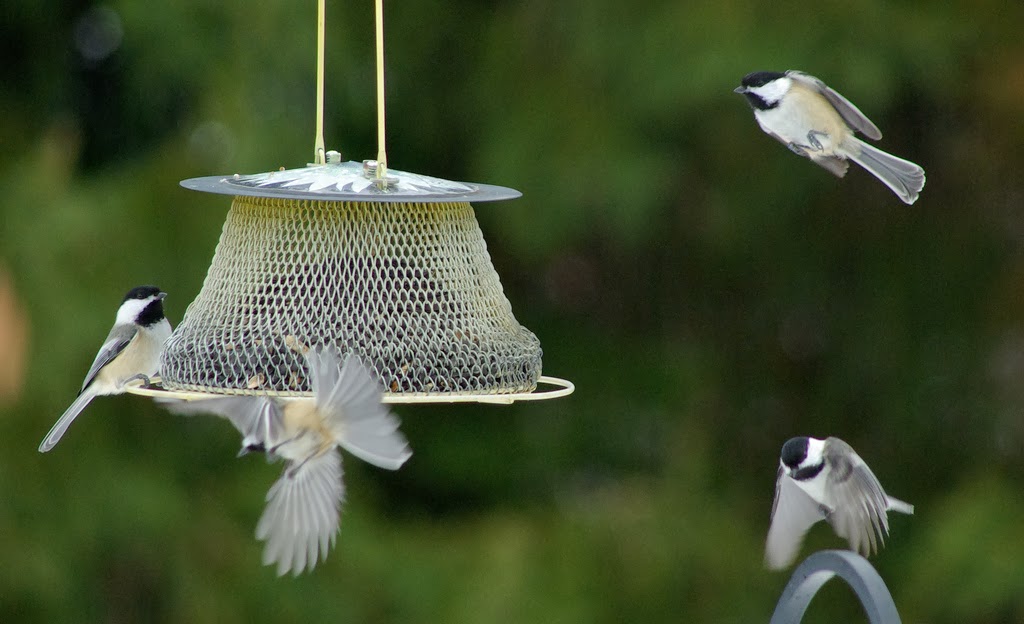
Chickadees at the feeder (Ano Lobb)

One of the ways everyone can contribute to our understanding of birds is by submitting your observations to eBird. Many don't feel their observations of birds in their backyard isn't important but that is not the case! Tracking the patterns of backyard birds can help us better understand the impacts of weather, pollution, urbanization and other forces on all bird species.

Since this backyard bird information is so important the Great Backyard Bird Count (GBBC) was created as an annual four day event to encourage everyone to pay attention to what is in their backyard and submit data so we can compare across big areas and between different years.

The count is done in February before most species start migrating so it will help us understand the distribution of bird species which are residents, or of species like Juncos which may only be around during the winter months.

The 2014 GBBC is February 14-17th and I encourage all of you to spend a few minutes watching the birds out your window, or along your drive/ride to work and submit what you see. It's really interesting to see what people find. Some species, like Northern Cardinals have made big expansions recently, where as others ranges have reduced.

All the GBBC information will be submitted to eBird and participating in the GBBC is a great way to get familiar with the website and maybe start a habit of submitting your sightings more often!


Friday, February 7, 2014

How to Cook in Your Car

You're cheap.

Like barely have enough gas money for this trip, cheap.

Four hours into your weekend warrior adventure, and you're just now realizing you forgot all about eating.

It's ok, we've got you on this one. This is the definitive guide to eating (cheaply) in your car.

Starting off, fast food is definitely the wrong way to go.

If you ate out for 3 meals a day that would cost you at least $15 (and that's being conservative). Multiple that by 7 days and you're already spending $105 on food. That doesn't even include snacks and drinks along the way! We can't be efficient Travelers on a Budget if we keep spending so much money.

They are various ways to save money on food, some are more extreme than others.We'll break them down into 3 categories of extremeness: Amateur, Intermediate, and Advanced.  That way you can choose how crazy you want to go.

-----------------------------
Amateur
-----------------------------
This is the classic example where buying food early rather than for convenience will save you money. If you're the snacking type buy all your goods at the grocery store before your leave. Common cheap snack items include:

-Chexmix (don't be afraid of off brands)
-Granola bars
-Sunflower Seeds
-Trail mix
-Peanut-butter Crackers
-Fruit (you can buy a whole bag of apples or oranges for cheap that lasts you for a week)
-Dried fruit
-Cereal (works double as breakfast and a snack)

One thing to watch out for is the amount you snack on the road. Driving can be boring, and idle snacking leads to not unnecessary eating and spending. Try to keep the snacks to every couple of hours.

If you really like to drink soda, buy a 12 pack beforehand. The $3.00 for 12-12 ounce sodas is a much better deal than $1.50 for every 20 ounce at the gas station.

A well seasoned road warrior and camper always brings water with them. It's a good idea to buy a couple gallon jugs of water before you leave, and then fill them up as you need too. That way you don't waste too much plastic and are more likely to have enough water with you. Its easy to forget to drink enough water while driving. That morning coffee and afternoon soda are only going to make it worse. To incentivize drinking water, I buy powdered Gatorade. For about $4 you can buy enough Gatorade to make gallons of Gatorade. Just use a fraction of what it suggests, and you'll find yourself drinking more water and wanting soda less.

If you're traveling a lot, don't forget to buy ice. Just having a cup of ice with whatever your drinking makes you feel more satisfied and happy. Cutting costs at the expense of comfort can start to put a toll on someone mentally and  emotionally. Little creature comforts, like ice, can help cut that cost.

---------------------------------------------------
Intermediate
---------------------------------------------------
The middle ground is where you strike the balance between saving money and not coming off as crazy. Good ideas are to bring your own food fixings for meals, and make them at rest stops.

We love rest stops. To the savvy traveler they are like mini hotels on the road. You should feel just fine bringing your peanut butter, jelly, and bread to the picnic tables to make lunch. What you may not know is most place are fine with you cooking on a small cooking stove. As long as they're up off the grass and on a surface you're fine. Which means your favorite cooking friend can now be your favorite travel companion!

Some stoves like these coleman are fairly bulky but pack up well
Others like this MSR are great for backpacking
These stoves come in various types including ones that are more compact than others. Once you start using camp stoves a whole world of food opens up. Good items you can mae with minimal effort include:

-Sandwiches
-Soups
-Chilis
-Eggs
-Pasta
-Beans
-Hot dogs
-Mac and Cheese
-Ramen (add a can of veggies for a cheap and easy soup)
-Oatmeal (dress it up with peanut butter, chocolate chips, fruits, nuts, or honey)

As summer approaches we'll be highlighting good traveling recipes, and a section on camp stove.

---------------------------------------------------
Advanced
---------------------------------------------------

Make sure to bring a can opener
This is the hobo level of eating cheap. Here you stop caring about what others think, and even what you feed yourself. Economy and efficiency are key.

Canned foods like tuna and chili don't need to be heated up and don't sacrifice too much in taste. The key I found to eating canned food cold is bringing spices and hot sauce. One quick dab of hot sauce can upgrade any food to a higher pallet. Adding other items like bread add variety and texture to an otherwise boring meal.

Many foods out there just require water, they dont necessarily even need hot water, just luke warm water and enthusiastic mixing. These items are great because they require very little cooking and preparation. These include powdered mashed potatoes, eggs, and basically anything dehydrated

Some items specifically require hot water, which can be hard to get a hold of. For this it's great to buy a cheap mugwarmer. Many of these models will plug into a usb outlet or car port. They're great at maintaining a beverages temperature but vary in their effectiveness of heating up lukewarm water. Plug one in about 30 minutes before you need hot water. Once it's a little painful to stick your finger in it's ready to use. The lower temperature usually require at least twice as long of cook time.

It's good to remember they're not designed for boiling hot water. There's a battle between making something that heats up to a high temperature and being a fire hazard. Don't get too frustrated if it heats up slowly.

Gas stations usually have a special spout on their coffee machines that just dispense hot water. They'll charge you for the cup (~$0.25) but you get steaming hot water for your tea and oatmeal in the morning.

Some items you can make with just a little warm water:

-Ramen (cup of soup)
-Easy Mac
-Oatmeal

---------------------------------------------------
Caffeine
---------------------------------------------------

God put caffeine on this earth for the same reason he made saturday morning cartoons, to force man to wake up early.

Making hot tea in the desert
The problem is most cheap forms of caffeine require hot water. While it would be hard to call tea and coffee 'expensive' the trend in the last 10 years is to charge as much possible for someone else to make it for you. For the travel less worried about this, truck stops usually do a good job providing coffee, and many places will charge you less if you're bringing in your own mug. The larger truck stop are usually so stuffed full of coffee types and creamers you'll feel down right spoiled.

If you're looking for a cheaper way you can make your own coffee and tea. Tea is an especially great traveling item. I would highly suggest switching over to tea while travel. It's cheap and always easy to make.

Unfortunately many of us refuse to switch to tea, so we're stuck trying to make do.

Instant Coffee-

Natural Austerity does not condone the use of instant coffees, except one: Starbucks Via. You pay for the better taste (~12 for a $10), but they're pretty delicious. The way they make it is sort of a secret, but from the description their process is legitimately different from  instant coffee creating a unique taste almost like real coffee. The price per unit (~$.83) is cheaper than a cup of a coffee at a gas station, but only marginally so. But they're indispensable for camping trips!

Make your own-

Wikicommons: Leland
The best way to make your own coffee is with a french press. You mix coffee and water together, wait a couple minutes, and then 'press' it, separating the coffee grounds from the water. The great thing about french presses is you can always add strength by letting it sit in the carafe longer. This is actually one of the better ways to make coffee, the problem is lugging a french press around can get a little annoying. They're usually made of glass and can break easily. REI sells a traveling mug/press. You have to pour it into another container after pressing it, otherwise the ground at the bottom with make the coffee more acidic the longer ti sits.

If you want to make iced coffee, put less grounds in, and let it sit overnight. In the morning, add ice and you've got tasty iced coffee.

**Protip: For easy tea without hot water, put 2 tea bags in a your water bottle and throw it up on the dashboard. It may take an hour, but eventually you'll have sun brewed tea! (Not so ironically this works well in the desert where there's an abundance of heat coming in your windows)**

--------------------------------------------------------
The Numbers
--------------------------------------------------------
So we sacrificed junk food for more miles, what did we really save here?
Lets say in the morning you made instant oatmeal in the morning ($0.30) and drank a cup of tea ($0.50) plus ($0.25) for the hot water to make it.  For lunch you made a peanut butter and jelly sandwich (we'll say that you can make 20 sandwiches for $10 of materials) that's $1 for 2 sandwiches. After lunch you snacked on an apple($0.75) and a granola bar ($0.50). Then for diner you ate a hearty meal of chili ($1.50) and mashed potatoes($1). All together you spent $5.80 the entire day.

Compare that to the $15 you were spending earlier, and you saved ~$9. That's almost 2 days extra worth of food or 100 extra miles!
 --------------------------------------------------------

Thats it for now.
So stock up on food, start driving, and don't forget the coffee!
-Boone

Sunday, February 2, 2014

Why YOU need wetlands

Swan Lake National Wildlife Refuge, Missouri 
The southern shores of Lake Erie are where I fell in love with wetlands. I started exploring them in middle school and was captivated by the endless complexity and their year round beauty. Wetlands are home to unique plants and animals, like American Bitterns who make a song kind of like a milk jug being poured out and wetland plants with aerial roots which help them deal with the suffocating conditions of having their roots underwater 24/7. But beyond the interesting parts of wetlands there are some solid reasons everyone should care about them.

I'm here to tell you there are more reasons then just scientific interests for why YOU should care about wetlands and should be celebrating World Wetlands Day today!

From vernal wetlands who only have water a few weeks a year, to coastal wetlands which gain and lose their water every day with the tides, wetlands come in many shapes and sizes. Each wetland is the result of a specific set of environmental conditions, rain, ground water, soil, topography. But no matter what caused the wetland, they are all important to all of us.

This might seem like a broad generalization but it's true! Wetlands clean our water, protected us from floods, and provide habitat for wildlife including many different species which are commercially harvested and eaten round the world. They are also vital habitat for the wildlife we don't eat, including 1/3 of the threatened and endangered species in the U.S. [1]. 

B.K. Leach Conservation Area, Missouri 
Wetlands are Economically Important 

You might not think about wetlands as a resource for anyone other then wildlife but wetlands protect us and our food every day!

Three-quarters of the northern Gulf of Mexico's fish and other aquatic life depend on Louisiana's wetlands for survival [2]. While many of these species spend their adult lives in the gulf, they rely on wetlands as habitat for breeding and protecting their young. 

New York City found it could avoid spending $3-8 billion on a new water water treatment plant by investing $1.5 billion in the purchase of land around reservoirs in Upstate New York. These wetlands purify the water supply FOR FREE [3]. These wetlands also provide great wildlife habitat and recreational opportunities, so it's a great win-win situation for the city of New York and its wetlands. 

A U. S study of the role of coastal wetlands in reducing the  impacts from hurricanes found they provided storm protection services with an estimated value of $23.3 billion per year. [3] This is HUGE! While flooding is a part of the natural cycle the kinds of floods we often hear about aren't natural ones. Before we had lost so many of our wetlands they would have absorbed these large rain events and gradually released the water, helping to keep our rivers flowing year round.

Wetland Loss

We've lost over 53% of our wetlands in the U.S in the past 300 years and approximately 26% of our wetlands globally (most of those losses being in North American and Europe) [4, 5]. Much of this loss is due to draining for agriculture purposes and conversion into other kinds of human development. Wetland loss is a BIG problem, when wetlands are destroyed they can't serve their ecological roles. They can't absorb flood water or clean it, they can't be habitat for wildlife species, and often what replaces them almost works as an anti-wetland. Parking lots are designed to shed rain as quickly as possible, taking runoff and sediment along with them. Excessive runoff clogs up waterways with rain faster than they are built to handle, which can cause big problems for both the environment and people. These reasons and many more are why it is SO important to protect the wetlands that are still around and make sure that they are as healthy as possible. We don't have that many left so we need them to work overtime.

Ways YOU can help wetlands
Wetlands are awesome! (USFWS Pacific)

-Support local organizations who work to protect wetlands (Land trusts, state and federal agencies, county and city parks and other groups).

-Support legislation to protect wetlands.

-Volunteer and help restore and protect wetlands in your community!

-Recycle and help pick up letter so it doesn't end up in wetlands.

-Most of all, Go out and enjoy wetlands!

Wetlands are a treasure trove just waiting to be explored.

There is something to do every time of the year, whether you have 10 minutes or an entire afternoon new things can be found and explored in your local wetlands. Here's a few seasonal suggestions.

- Go out in the spring and look for the wildflowers and birds, stop by in the evening and listen for the frogs.
- Adventure out in the summer, look for snakes sunning themselves, birds feeding their young.
- Return in the autumn to see the beautiful colors and migrating birds.
- Visit again in the winter to see the beautiful patterns in the ice and to check for any winter visitors.


Needs some help getting started exploring your local wetlands? Check out these great resources.
Murky and Quirky - Appalachian Mountain Club
Wetland Scavenger Hunt - Wisconsin DNR
Walnut Creek - A guide to exploring urban wetlands.


__________________________________________________________________________

[1] http://water.epa.gov/type/wetlands/fish.cfm

[2] http://shreveporttimes.gannettonline.com/gns/wetlands/


[3] http://wwf.panda.org/about_our_earth/about_freshwater/intro/value/

[4] http://www.npwrc.usgs.gov/resource/wetlands/wetloss/findings.htm

[5] http://www.ramsar.org/cda/en/ramsar-news-archives-2002--a-global-overview-of/main/ramsar/1-26-45-87%5E16905_4000_0

Thursday, January 30, 2014

Bird Questions: How Do Birds Survive Cold Weather?

When the polar vortex descended into the United States in early January I got questions from several friends concerned and curious about how the birds would deal with these conditions. To help answer that curiosity we bring you the first installment of Bird Questions.
--------------------------------------------------------------

Cold weather challenges birds ability to survive in several unique ways. While many species of birds migrate to avoid these challenges other species have developed physical and behavioral adaptations that allow them to not only survive but thrive through the winter months.

-----------------------------------------------------------------
Physical Adaptations
-----------------------------------------------------------------

Feathers
Feathers make birds adaptable. Birds can live in some of the most extreme environments because
feathers are so good at helping birds thermoregulate (keeping their bodies at a comfortable temperature). Feathers are remarkable because they help all birds stay comfortable, no matter what climate they are in. For birds spending the winter in cold places they have many more down feathers which work to keep them warm. 

Down feathers are small and have loose barbs which trap warm air. The down works like a warm insulating layer and on top there are feathers designed to keep out the wind and the water. These overlapping feathers work like shingles, shedding water and deflecting wind. This combination works much like the layers that people wear in the winter to keep warm, they trap in warm and keep out the cold.  

Diagram of counter current heat exchange 
http://freewebs.com/gta101/arterieskw99.jpg
Legs and Feet
Most birds don't have feathers on their legs and feet which leaves them exposed Heat sinks are parts of a system where heat is lost. Counter-Current Heat Exchange  is used by birds to to minimizing their heat loss and preventing any damage to their feet from the cold.

Counter-current heat exchange works because birds arteries are wrapped around the veins in their legs. When these two vessels come in contact it allows the incoming warm blood from the heart to heat the cold blood coming from the feet. Exchanging heat prevents the bird's core from having to work as hard and keeps the feet from freezing. 


-----------------------------------------------------------------
Behavioral Adaptations
-----------------------------------------------------------------

Constant Feeding
Birds can gain and lose weight more easily then people. Many birds, especially small ones will spend most of their time during cold weather feeding [1]. Crazed feeding allows them accumulate enough fat to make it through the next night. Many birds will spend all of their day light hours eating or looking for food when the weather is cold. Songbirds probably spend most of the day actively searching. Their need for food is the reason you see them pile onto birds feeders. Smaller birds have higher metabolisms then raptors so they need more fat for how big they are. These large fat reserves laid down every day will be burned off overnight due to their high energy requirement. Raptors will often revert to the least energetic method of searching for food. Raptors may soar or spend time just perched looking out for prey items.

Posture
Just like how a Northern Cardinal can change the position of the feathers in its crest, birds can change their body posture and feather position to keep themselves warmer. By puffing up and making themselves as round as possible birds conserve the most warmth. As a bird forms a more round shape the ratio of surface area (outside of the bird) to the volume (the body of the bird) changes so the surface area is minimized for a particular size of bird. By minimizing surface area the amount of heat which can be lost is limited and puffing up their feathers helps limit heat loss even more.

Birds have a very aerodynamic shape and by orienting themselves to face into the wind the wind passes over them quickly. This is especially important in wet environments since down feathers lose their warmth when wet. By facing into the wind the birds feathers can work like shingles and shed the rain, protecting their warm downy undercoat.

Bluebirds huddling for warmth (Michael L. Smith)
Night Roosts
Several species of birds have been documented to huddle together in the winter, often in cavities or nest boxes to keep warm [2, 3]. These flocks are typically the same species, but are not necessarily related family members. Both Eastern Bluebirds and House Wrens are known to do this. Providing shelter for roosting birds is one reason to leave birdhouses up over the winter. 

Torpor
Most people are familiar with hibernation, but some bird species engage in another method of surviving daily torpor. Torpor is a bit different then hibernation, individuals come in and out of it on a daily basis, rather then a season one. Their body temperature is also not lowered as much as individuals who hibernate. It still serves the same purpose, lowering your body temperature means you have to use less energy to stay warm, If you were to encounter a bird who was in torpor it would probably appear to be sleeping but would not quickly awaken as you approached. This slow response to disturbance is one reasons individuals probably don't to into torpor every night, it leaves them more vulnerable to predators and other hazards, but when cold weather strikes it can be a valuable tool [4].

-----------------------------------------------------------------
How You Can Help 
-----------------------------------------------------------------
While birds don't NEED your help to survive the winter, during extreme weather there are a few things you can do to assist birds in surviving cold weather.

High Quality Food - Suet might seem a little odd, since it's basically just animal fat with seed mixed in, but it's pure energy to many bird species and can be a very high quality food source. More important then the kind of food you put out is to decide whether or not you will be feeding all winter. If you not, its best to taper off the food in the fall instead of just stopping in the middle of a snow storm when birds may have difficulty scouting out alternative food sources. 

Shelter - Plant evergreen shrubs (plants which keep their leaves or needles year round) around your yard so birds can find protection from the wind/rain/snow. To prevent your bushes from being used as cover for predators (such as cats) keep the bushes back from feeders and bird baths. 

Water - Staying hydrated is just as important as food, and often more difficult to find. You can use a heater or dripping water to keep a bird bath open. During the winter it's often best to put sticks or other perches around the bird bath since birds wont want to actually bathe in cold temperatures. These perches allow them to get easy access to a drink. 
-----------------------------------------------------------------

One of the remarkable things about birds is their ability to survive extreme conditions. Take some time over the winter and watch your local birds at the feeder and see if you catch them exhibiting any of these adaptations. And if you have any other bird questions drop us a line - naturalausterity@gmail.com

- Auriel

-----------------------------------------------------------------
[1] P1.101  Friday, Jan. 4  Do small wintering birds adjust their metabolic performance in response to perceived level of cold? MILBERGUE, M.*; BLIER, P.; VEZINA, F.; Univ. of Quebec in Rimouski; http://www.sicb.org/meetings/2013/schedule/abstractdetails.php?id=738

[2] Mayer, L., Lustick, S., Battersby, B. (1982) The Importance of Cavity Roosting and Hypothermia to the Energy Balance of the Winter Acclimatized Carolina Chickadee. International Journal of Biometeorology. Volume 26:3 p231-238 http://link.springer.com/article/10.1007/BF02184939

[3] Kendeigh, S. Charles. (1961) Energy of Birds Conserved By Roosting in Cavities. The Wilson Bulletin. Volume 73:2 p140-147 http://www.jstor.org/discover/10.2307/4158912?uid=36852&uid=3739536&uid=2&uid=3&uid=67&uid=36848&uid=62&uid=3739256&sid=21103359393693

[4] Geiser, F. and Ruf, T. (1995) Hibernation versus Daily Torpor in Mammals and Birds: Physiological Variables and Classification of Torpor Patterns. Physiological Zoology. Vol 68:8 p 935-966 http://www.jstor.org/stable/30163788

Thursday, January 23, 2014

Rare Bird Alerts and You

You woke up this morning, looked at yourself in the mirror, and decided to be completely honest.
You have a problem.
You took the journey down the rabbit hole, and came out a twitcher.
You're addicted to birding.

It happens. You could have chosen sex, drugs, alcohol, or birding. We at Natural Austerity would like to think you made the better choice. 

This is your support group. We're going to support you in your new addiction.
__________________________________________________________________________________

But first, for some of you who don't know the dirty words that are said to you behind your back.

What is a twitcher?
A twitcher is a person who chases rare birds and goes to sometimes extraordinary lengths to do so. These are the people who take off lunch breaks to go chase a county first record Spotted Towhee or first of the year Eastern Peewee. It's sometimes quite arbitrary in the grand scheme of things how rare is the bird. It's just important if it will be a first somehow.

A lister is someone who's main goal is to see as many birds in a predetermined amount of space and time. Listers run the gamet of extreme listing (big years) to more innocuous listing (life lists).

Twitchers and listers are many times synonymous. These two types of birders get a bad rap not only in the birding but conservation community as well. When you run around on a frantic quest to see as many birds as you can, you lose a certain amount of appreciation for the moment. It can be difficult to really sit down and appreciate a new life bird if you know your day light is fading. The most extreme stories of birding usually come out of these camps. Adding to their bad rap, a fair amount of trespassing and illegal behavior has been associated with finding new rare birds and being the first to do so.

So A Warning
Evolution took millions of years to evolve not just one of these airborne pioneers but over 10,000 different species of them. This is a family with members who once darkened the sky with their sheer numbers, and are capable of heroic migration sometimes spanning the entire globe. It's because of this we encourage you to take more than a second to appreciate every new bird you see. It is a wonder not only that they're here, but that you are born in a economic situation that allows you to enjoy them freely.

With that we'll move forward
---------------------------------------
Ebird

Ebird is your first level go to for rare bird alerts. This extremely powerful online data set tracks users entries and allows you to see whats being seen on the ground within hours of it actually being seen

As part of Ebird's data screening process for citizen science data, these filters flag submitted birds as 'rare' based on expected birds in the area, time of the season, and particularly high counts.Ebird's volunteer editors use this as a first defense for screening new data for anomalies. Common year round residents like chickadees will not be flagged, while birds not from the area or arriving at a strange time will show up as rare and require a review by the local Ebird editor. All of these 'rare' and unusual sightings can be pulled up together in a convenient list.

Head over to Ebird, log-in and clicking the 'Explore Data' tab. Scroll all the way to the bottom and click the 'Alerts' section.

In Alerts we can play around with various regional alerts. The regions you can choose include states, counties, or countries. For example, if you type in 'Pennsylvania' into the 'Rare Bird Alerts' section, Ebird will show rare birds seen in that last seven days in Pennsylvania. If you type the same thing into the 'Needs Alerts' section, it will show you reports of birds you haven't seen in Pennsylvania

The way to get the most of this option is to sign up for daily rare bird alerts in your state and county. If you live in a large state or a highly birded area, these emails can get rather long. The county list ameliorates this by giving you a more focused list.

More advanced birders may want to choose to receive hourly lists for their county. The great thing about this is you learn much quicker about the rare birds, and can react faster. Most of the time, the hourly list will be manageable. If you live in a sparsely birded area you may not even receive alerts for days. However, in largely populated counties like San Diego county, these hourly lists quickly become overwhelming as rarities are reported almost every hour of the day.

One of the problems with Ebird and Ebird alerts is the sometimes very informal nature of the process. Birders are not required to tell you where in a patch they found them, and sometimes may just submit a list for a rather large area giving you almost no data to act upon. Not only that, not all birders use Ebird. Many older birders in particular refuse to use it, as it requires a rather large start up time importing your previous lifelist.
--------------------------------------------
BirdsEye

BirdsEye is a mobile app that integrates with Ebird to show you sightings for any area you choose. Available on iPhones, this is an incredibly valuable field tool that gives you up to date information in an easier to navigate interface. You can set anywhere as a center point and look at the species seen recently within a certain diameter circle. It will show you both common and 'notable' birds. Notables are birds that are rare or things you haven't seen (you can input your life list into the app).

You can pick a species and find the hotspots where it has been reported and plan your day from there. This can be a great tool when you are going to be traveling to a new place. You can scout out birding spots in advance and use it once your'e there.

Currently BirdsEye is only available on iPhone, but an android version is in production.
It suffers from Ebird's faults but is a plus because of Ebird's terrible interface on mobile devices.
--------------------------------------------
ABA Rare bird alerts/news

The ABA maintains a rather exhaustive list of rare bird forums separated by regions. The regions lists are somewhat chaotic as each area is divided differently. California, for example, is split into 24 different forums, while Texas is just a single entry.

A good feature of the ABA alerts is you can search for a particular states listserv by clicking here. Once there, you can sign up for any particular states birding listserv and receive updates by email.

The ABA RBA and News list is a great way to figure out the details of a particular bird seen. The posters are usually very detailed with locations, times, and update periodically if a bird was seen recently. In addition, many people will post trip lists. These can be a good way to prepare for an upcoming trip, and get your mind set on what you might see.
---------------------------------------------
State bird forums

The most intimate and interesting look into the bird world usually starts at the local birding forums. These forums are birders main way to interact with each other. In them, you'll find information not only about rare birds, but sometimes intimate details about someones backyard birds and life. If you're looking for birds that many wouldn't consider rare, this is a great tool to figure out what birds are in an area and where to find them.

To find a local bird forum you can simply go to the link previously mentioned in the ABA mailing lists or just search Google for an areas bird forum or listserv. You'll find these sites often tied to local ornithological or Audubon societies.

Love em or hate em, bird forums represent your fellow birders and their similar love and devotion for birds. As such, be nice on the forums. Birding is not something everyone does and it can be hard to find friends who share in your passion. If an old woman wants to discuss her coffee choices more so than the birds she saw, so be it. If that same woman wants to tell you how excited she is of her Jan 1st First of the Season Northern Cardinal, let her have it.

On the flip side, bird forums like anything on the internet can bring out the worst in people. The anonymity of the internet, mixed with the binary nature of sometimes very difficult bird ID, and the inherent competitiveness of birding can breed really snarky and elitists folks. A good reminder is to not take anything someone says personally. Bird IDing is difficult and no one is perfect. Some people just need to feel special. Ignore them and don't feed their troll like nature.
------------------------------------------------
Facebook

Why not marry the one site you never stop checking, with the obsession you never stop thinking about?

The ABA runs a great group called the ABA Rare Bird Alert where users post notable rare birds around the country. While not all encompassing and sometimes on a different schedule than the normal ABA site, this format can be a welcome addition to your Facebook news feed, and a much broader scale rare bird alert for you to stomach.

There are many regional bird groups on Facebook, including many that are just for particular states. These function similar to bird listservs but are much easier to navigate and scroll through. Adding them to your facebook feed is an easy way to keep up to date with whats going on in the bird world and stay apart of sometimes good bird discussions.

They suffer from similar faults of listservs, as moderating some of the larger pages can sometimes be a daunting task. Remember to respond politely to other members. You'll usually get a nice response back.
-----------------------------------------------
The North American Rare Bird Alert (NARBA) 

The North American Rare Bird Alert is a long running and iconic service which started in 1985 as a way for birders to share their rare bird reports. It's evolved from a telephone service run by a single person, to a large scale website able to notify customers instantly of new birds found around the nation.

For a fee of $50/year you can get detailed reports of rare birds including past sightings, locations, and verifications. It's the premier bird alert service used by most big year chasers.

We don't strictly condemn the use of the NARBA, it is the best resource to find all of these reports in up to the minute detail. But as budget bloggers we tend to shy away from it for cheaper alternatives. You can find most of all the information in the NARBA on the internet. It just takes much more time and effort.
-----------------------------------------------
Misc outlets

Koppi2 (wikicommons)
In certain communities rare bird alerts have evolved to their final form. Mobile SMS push notifications. My labmate and fantastic birder, Tim Schrekengost, helped set up the Delaware rare bird alert onto a mobile app called #Groupme. Users download the app, sign up to the group, and post their sightings instantly. These posts get sent straight to everyones phone, allowing literal real time sightings. This decreases your reaction time down to seconds.

This worked particularly well this last Black Friday. While my friend Emily and I were shopping around Rehoboth beach, I received a text message that a Snowy Owl had been reported just 10 minutes away. Needless to say, we stopped shopping immediately and rushed down to the beach. Without even our binoculars in hand (rookie move) we managed to catch the owl within an hour of it first being sighted. Truly the internet is a beautiful thing.

I expect many more options like these will crop up as technology increases and people find more unique ways to post their sightings.
-------------------------------------------------

That's it for now. Hopefully now you'll sign up for rare bird alerts and forums in your area. This way you'll become more involved with the bird community, learn new places to bird your local area, and be better prepared for planning your next long distance birding trip!

So go forth, sign up, and be overwhelmed by rarity reports!

-Boone

Thursday, January 16, 2014

How to Enjoy Cold Weather

Even sub-zero days offer great opportunities
to explore. UP of Michigan December 2013 (Auriel Fournier)
It's -47F with the windchill, my jeep barely starts, my lungs hurt, but eventually the jeep stops squealing and we're on our way for another day of birding. When we planned our long weekend of birding in northern Minnesota I promised Matt the cold 'wouldn't be that bad' (since it normally isn't). So he bought his plane ticket in balmy October on my promise of great birds.

January 2nd arrives and twelve hours of delays later he arrived in Wisconsin with no luggage, just the coat on his back and a polar vortex headed our way bringing some of the coldest air in 20 years. Luckily we are all very flexible travelers and between Nick and I, we had enough warm clothes to convince Matt he wouldn't die and we headed to Minnesota.

We worked with the weather, made lots of changes along the way and our trip was a success. We didn't spend as much time outside as we planned and ended up doing most of our birding from the car, but we had a great time and all of us experienced winter in a new way. That -47F degree morning though with the wind blowing and all of us wearing so many clothes its hard to move I thought we were a little bit crazy. Then the sun came up, the beauty of northern Minnesota showed itself again and we managed to stay pleasantly warm because we were prepared for the conditions.

Typical winter days offers even more possibilities. When you dress for the weather, a hike on a single digit day can be just as enjoyable as one on a fall afternoon. Being cold outside is easy. I've been there many times. I went to school in the Upper Peninsula of Michigan and I made every rookie mistake before finally figuring out how to enjoy winter like a yooper. Today I'd like to show you some of those mistakes and how to fix them so you don't make them yourself. Not all of us need to do a 12 mile snowshoe with frozen pants and no feeling in their legs to learn these lessons.

With a little bit of knowledge anyone can dress to be comfortable in the cold.

---------------------------------------------------
Layering
---------------------------------------------------

Layering keeps you warm and is simple once you know the basics. You need to wear clothes to hold in the warm air and block the wind. Once you've got on good layers there are just a few additional things to remember. Know your body and dress accordingly. If you are like me and your hands/feet get cold easily put more layers on your arms and legs to compensate. Always ensure your layers overlap at your neck, waist, wrist and ankles. These overlapping layers seal in the heat and will prevent cold air from leaking in.

I always err on the side of wearing too much, since you can always shed a layer. You can also do a quick check when you first get outside, stand for a moment and see if you can feel the cold air seeping in. If you can then you probably need an additional layer or to adjust what you are wearing. 

---------------------------------------------------
Equipment
---------------------------------------------------

Outer Layer - The purpose of an outer layer is to keep out the cold and wind, usually through a heavy winter coat. If you don't have one, a rain coat along with several layers of sweatshirts and sweaters underneath can work. Layering doesn't just apply to your core, keeping your legs warm is important, and is probably the most neglected part of layering. You don't need to go buy fancy snow pants, you can cheat and wear a pair of rain pants with thermals/sweatpants layered underneath.

Base Layer - Wear loose clothes so they can trap air between the layers and a close fitting base layer to keep you feeling warm and wick away moisture. Most people will tell you to get a fancy synthetic shirt, and if you can afford Underarmor, wonderful. Cotton long underwear can also work just as well. Thermal base layers can be picked up for $5-10 at Wal-mart. Grab a top and bottom layer (remember not to forget your legs!).

Hats - Even if you are not a 'hat person' you need a hat. Otherwise your body will spend valuable energy replacing all the heat radiating away. Style isn't important, so find something cheap. A good hat will cover your entire head, the thicker the better. You can get hats for $5-10 at Wal-mart.

Gloves - You'll be warmest with a giant pair of well insulated gloves, but if you have to write things down, or really do anything, they might be cumbersome. There are many styles of gloves suited to different tasks. Some have flaps that flip back and become fingerless so you can use your hands. Your best bet is something with thinsulate. If you have to remove your gloves often get a thin pair of gloves to go underneath.

Scarf -  Scarves keep all the warm air around your core while preventing heat loss from your neck, another large heat loss area. Scarves can be worn different ways to help keep the wind off your face, which is great when wind chill is a concern. Just make sure you find something soft enough so it won't irritate your face.

Vests - I personally am not a vest person, but if you often find yourself being too warm vests can be a key layer because they keep your core warm without over heating.

Boots -  If you're going to be out hiking, or building a snowman a good pair of hiking boots and some thick socks are probably all you need. Make sure your boots aren't too tight. Tightness restricts the socks/shoes ability to trap warm air around your feet and makes your feet cold fast. Wearing a double layer of socks works really well to both keep your feet warm and prevent blisters but wearing more then two pairs can cause additional issues with not allowing space for warm air to be trapped.

Socks - Good socks are worth investing in. I love Smartwool, but there are now lots of brands of comfy wool socks out there, so shop around. Wool is important because your feet sweat. In your daily life you probably don't notice, but when you wrap your feet up in socks and boots the sweat does not evaporate. Leaving you with cold feet. Wool keeps you warm even when its drenched, which is why wool makes great socks.


---------------------------------------------------
Extreme Weather 
---------------------------------------------------
When the weather really cold it's important to take care of yourself. Check in with your group members and make sure everyone is staying warm. Take breaks, warm up inside, make sure you eat enough.

The first big issue with extreme cold is wind. Wind chill makes cold dangerous, FAST. Check out the wind chill chart from the National Weather Service. If the wind is strong at all you can come under danger of frostbite very quickly. The best way to combat the wind is to keep all of your skin covered, especially your extremities (hands, feet, ears, nose) and stay active so you keep pumping lots of warm blood to those regions.

Bond Falls, UP of Michigan
(Auriel Fournier)
The second big danger is water. Now chances are if its super cold out there isn't much open water for you to interact with, but most of us live in places where cold means something around freezing, which often leaves things wet and sort of slushy. Once you get wet its really really hard to stay warm unless you are wearing special clothes. Above when I say you can get away with cotton I mean you need to stay dry. No wading through streams, no falling through the ice, no standing in the freezing rain, no sliding down winter waterfalls. If you are going to be doing something where there is a good chance of you getting wet then you need more specialized equipment which is often not cheap but is well worth it. Being cold and wet is dangerous, please be careful. 

Please use this info to help yourself enjoy the outdoors, not push yourself to dangerous limits. When the weather is extreme always make sure it's smart to be out doing what your doing. Several days of our trip we planned to be out snowshoeing all day, which at -30 or -40 is not safe, so we changed our plans and did short hikes (<15 minutes) and explored in the car. Sometimes an alternate plan for the day may be in order and that is OK. Part of the wonder of the outdoor world is the extremes of its weather and experiencing them is fun, but don't throw caution to the wind. A five minute experience can be more then enough for the conditions.

Most of the time though the weather is more mild and dressing for the weather is fairly easy. It may take a bit of trial and error before you get layering perfect, but the rewards are fantastic. Winter is (in my opinion) the most beautiful time of year and winter offers opportunities for exploration and recreation you can't do in any other season. Being active all winter helps fight winter depression and opens your up to 12 months of fantastic adventures! So pull on some extra layers and get out there!

Thursday, January 9, 2014

Traveling on a Budget: Why you should (occasionally) stay in a hotel

Tips for the hobo traveler
I just went on in this whole post about why you should never book a hotel early, infact I would argue strongly about why you should never book a hotel at all. But there are a few reasons why strategically booking a hotel may be to your benefit. I'll admit this next section is mainly for the extreme saver travelers who have listened to everything I've said, and forgotten what normal people do while on vacation. We all need to be reigned in occasionally.
----------------------------------
First off hotels have amenities. Yes, thats kind of what they're selling you. Even you, the savy vagabond travler, may benefit from them.

-Hot Showers: Yes, I know, truck stops have showers as well, but you still have to pay for one, and showering in your own hotel room might just be a little more comfortable. An adventure can always be better the more comfortable you are, and a nice hot shower may just re-energize you for that next long stretch of extreme traveling.

(Elvert Barnes)
-Internet: Of course, you could just sit in Starbucks drinking 3.95 lattes all day while you finish blogging, telling your mother you're alive, and scouring the rare bird alert pages.

-Breakfast: Maybe you're tired of heating up oatmeal in your car every day, or were going to spend $5 buying Whataburger tacquitos and a large coffee anyway. Now you can save that money and eat normal food, like cereal!

-Water: It's not always easy to find a good place to replenish your water supply and the alternative is to buy another plastic recycling nightmare from one of those silly companies that believes it has the right to sell something that makes up 75% of you.

-Sleep: No matter how much you may love sleeping in your pimped out car or out in the stars, sometimes it does a body good to get one good nights sleep.

-Weather: It doesn't rain inside. Perhaps that rain storm just rolled in and you were planning on camping tonight. Or the low is down to 15 and you're sleeping bag is only good for 30. Not being miserable can be reason enough.

-Football: Or whatever sport you love. So, you were going to take the night off, spend it at a buffalo wild wings stuffing your face so you could watch the big game. Better yet, just watch it in the privacy of your own hotel room, that way you don't even have to wear pants!

-Safety: Maybe sleeping at the Park and Ride tonight isnt such a good idea... 

----------------------------------
So lets do the numbers, how much is all this really worth?

Let's say you catch a sweet hotel deal and only spend $40 after all the crazy taxes.

Shower- Truck stop showers are usually around $10 for us non-truckers
Internet- Let's say you were going to buy a $4 latte at Starbucks for a couple hours on the internet.
Breakfast- Your breakfast can average anywhere from $1 to up to $8, lets average that and say $4
Water- Buying a couple liters of water could cost you around $2 a day

These base line costs are already worth $20
Lets dig deeper and say it kept you from eating out for the big game which you would have spent $10
Altogether that's already worth $30 of our $40

So what are comfort, sanity, and sleep worth? It all depends. Maybe you haven't found a good enough way to sleep in your car. Or you just had too many wet days in the field. Maybe you forsee that pitching a tent tonight in the rain is going to ruin your mood for the rest of the trip. In that case the intangible for sanity is almost priceless, and definitely worth the extra $10. I wouldn't use this post as a crutch for spending money, but as a check when you think you've gone too far.

My strategy is to spread out hotels sparingly every couple days or so just to get a shower and internet. I couple that decision with one where I was going to be in a difficult sleeping situation anyway (like in a city) or when I need to be close to my destination tomorrow. This way I stay true to my goal but allow myself some comforts. Always evaluating the cost of items and being forced to justify their purchase helps you realize the real cost of things, which is the first step in spending smartly.

So travel forth, and remember your sanity!

-Boone

Thursday, January 2, 2014

The Importance of Being on Time

As I sit in the terminal of Chicago's O'hare Airport with hours to kill, I almost look like a genius. This is a strange feeling because hours ago I felt like a tremendous idiot. Again, like many times before, luck pulled me out by the skin of my teeth. Just 12 hours ago I was quite the opposite, frantic, no sleep, driving much too far to catch a plane that I've known about for months.

This is not my first time, it probably won't be my last. But lets look at what happened today, and see how we can learn from it.

--------------------------------------

I get cocky sometimes. Well actually its just laziness covered with the veil of cockiness. Three months ago I bought this plane ticket: A trip to northern Minnesota and Wisconsin for some fantastic winter birding. But two days ago, my indecisiveness got the better of me. I was slated to fly out from Fayetteville, AR Thursday 11am. Without doing any traveling calculations, I promised a friend I'd spend Wednesday night with him in Dallas.

    'I've got this, it'll be fine', I kept telling myself.

I knew the the times were a little off, but I figured it'd be fine. Most of my plans are various forms of 'winging it', and they always turn out ok. They're sometimes not very pretty, but I make it work.

5pm Wednesday night (18hrs before departure)- I land at my friends house later than I planned and commit myself to spend as much time as I can with him before I go back to Delaware.

11:30pm (~12hrs before departure)- Already groggy, I start to google maps my drive to Fayetteville, and do my infamous tired time math.

    'Uh-oh, buddy I gotta go to sleep, like right now', I announce suddenly.

With my fuzzy math I've just realized I've got to get up at 4:00am to drive 5.5 hours to navigate an airport I've never been to. 

    'It's ok, I can just sleep on the plane' I lie to myself. I know I can't sleep on planes.

4:00am(~7hrs before departure)- I get up groggly, much too early, get to the car, forget my keys in the house, come back. Fail to navigate to the correct airport on my gps. Manage to find the right airport. Punch it in the GPS. And then handily get myself lost in Dallas. With a GPS. I take the 3 different wheels in a multiple highway interchange, before managing to get going in the right direction.

    'I should have slept more', I grumble to myself. Three hours before the sun even comes up.

That's when I realize all of that fuzzy math last night was using Dallas toll roads. I'm not taking Dallas toll roads. More fumbling, grumbling, and I'm out of Dallas and one hour later than I expected.

5:00am(~6hrs before departure)-I'm 5 hours away. If literally nothing goes wrong I will make it with just enough time to park, walk from the economy lot to the terminal, check in, get through security, and board the plane. In an airport I've never been too. What a stupid thing to happen. Every gas station, coffee stop, bathroom break I watch 5 minutes tick down.

    'I knew better than to not factor in those stops' I chastise myself.

9:30am(1.5hr before departure)- After a very uncomfortable drive watching the google maps ETA ticking up I receive a phone call.

A snowstorm in the midwest has delayed my flight by 2 hours.

And suddenly it's all Ok, I'm saved. I went from late to early. At the ticket counter I reschedule my flights for later times in the day, get on the plane, and land in Chicago only 2 hours later than anticipated.

--------------------------------------

6:30pm- Here I sit now, in the middle of a 6-hour layover in Chicago, feeling the opposite of how I felt 12 hours ago. I'm surrounded by many angry people. This storm coupled with some impressive lake effect snow, has thousands of people in the airport angry. Delayed flights, canceled flights, everyone seems angry. But not me.

Auriel and I's propensity for open end planning lead this rather large climactic event to effect us very little. I called her after I rescheduled the first plane ticket, asking if a 7 hour delay was ok. She was fine with it. We talked about the possibility of being stranded overnight in O'hare (still a possibility), not a big deal.

The Journey is the Adventure applies at every step of the process here. Being a very maleable traveler, spending the night in an airport won't effect me that much. I just keep my expectations muted. Even this is highly comical. Whatelse would I be doing right now? Probably sitting in bed doing the same thing I am now. Except I wouldn't be in Chicago, I'd be the same place I usually am, and probably bored.

Auriel's planning for this trip is really open ended. Birding in winter can be very unpredictable, and as such expectations are more of an unknown than anything else. We can change hotels if we want, we can make it to any part of the trip whenever we need to. We'll just shift plans as the come. Where life dictates we go, we'll go, because that's pretty much the only thing you can do. You need to remember there's always a plan B. It may not be close to what Plan A was, but there is another way.

Murphy's law moves our lives around in tumultuous ways. I think that's why the journey is the adventure works. It makes hurdles into turns, you just have to mute your expectations. Expectations are what every angry passenger in this airport has. No, I'm not saying they should all live like this. Many of them have kids, business to attend to, other peoples lives to deal with. Just something to think about when your planning your next trip.

--------------------------------------

The next lesson to learn is the flip side to this argument. The importance of knowledge and giving yourself plenty of time to deal with the problems that may arise.

My fuzzy night time math has hurt me more than once. Making important decisions while your sleepy tends one towards shaving time too close. This creates the travel stress we're all looking to avoid. The reason many of my trips have worked out, despite the complete lack of planning, is how I didn't have a strong schedule to adhere too.

If you couple that with proper planning, calling ahead, seeing when things open, where things are, and thinking properly about what the real life time costs are, then you'll be winning the travel game.

It's something you probably know you should do, but expect thing to not go as they should. Add extra time to your calculations, and don't allow yourself to cut things too close. The stress is almost never worth it. There is a limit on trying to do too much versus your own happiness. Would you rather do 1,000 things crappily or 1 thing really well? While listing lends itself too doing 1,000 things half-assed, we should normally tend towards the latter.

Trust me, that frantic feeling sucks, but for now it's all landed in the realm of 'manageable'.

--------------------------------------

Update-7:44pm, and I've been delayed again 3 hours. Hopefully I'll make it out of this frozen airport by tonight. I've got some birds to see.

10:50pm-ive been delayed further till 1150 now. Perhaps I should start finding a nice corner?

-Boone