Thursday, March 27, 2014

How to watch migration

Golden-winged Warbler, Minnesota, 2010
Spring 2010 I got hired to travel all over Minnesota and Wisconsin in search of Golden-winged Warblers. That job is how I originally got introduced to eBird.  Every day, starting in April, I checked the Golden-wing map to see if they had arrived in Wisconsin yet. Finals were the last week in April and my crew was set to jump in the vans and head to Wisconsin as soon we finished our exams. We were just waiting for eBird to show us if the birds had arrived, and arrive they did!

Checking eBird every day and watching eagerly for those points to get farther and farther north got me addicted to checking eBird and diving into the immense amount of data eBird has about bird migration.

eBird is a treasure trove of information. Its a great way to learn about a new place and it provides us really neat ways to look at how migration varies from year to year. It also provides you near real-time data so you can see what is going on with migration RIGHT NOW! This makes it an addictive tool, especially in the spring when I am chomping at the bit for all the birds to come back. 

How do you do this? It's quite easy, go over to eBird.org and click on 'explore data', then click on 'range and point maps'. In the upper left hand corner type in the species of your choice. Right now it's mid march, and the Purple Martins are starting to make their way north, so lets take a look at these signs of spring.

So the first time you enter in Purple Martin it's going to show you everywhere a purple martin has every been recorded. Crazy, and a bit overwhelming.

Next to the species slot is one labeled 'Date'. Checking these maps is where migration becomes watchable. Click on the date drop down and select 'current year'. Choosing this option limits the map to just the areas where Purple Martins have been observed during the current calendar year.

So check it out. I'm currently in NW Arkansas and I've been hearing reports of martins on the list serve for awhile. It looks like Purple Martins are just starting to push north of Arkansas. Since the Midwest has been getting regularly hit with snow over the past few weeks this is probably a wise choice on the part of the birds, though it looks like spring might finally be arriving!


By checking out maps like these for a wide variety of species you can watch migration happen and if you check back every day or every few days you can see the line of purple slowly move north and can better expect what might be around your favorite patch.

What is also fun to look at is how the current 'range' of a species compares to other years.

So head back up to the date drop down and change two things. Instead of current year click on 'last 10 years' and change the month range to just march (so March to March, it's weird, i know).

You should see something like this: Which presents a different picture.


Part of the difference between these two images could be because March isn't over yet, and chances are Purple Martins will make it farther north before April 1st. It might also show the difference between this year and the last, so check back at the map at the end of the month.

The big message here is bird distributions vary year to year. By looking at the 10 year image you can see the farther north areas are lighter purple, indicating less sightings. So not every year are Purple Martins back in Minnesota or northern Ohio by the end of March, but some years they are. Boone's post back at the end of February talked about how spring migration can be treacherous for birds, and how they delay their progress north until conditions improve. Birds are in a race against time, trying to make the most of the good summer weather and be the first ones back on the breeding ground. Some years this pans out and they make it farther north by the end of March. Other years, like 2014, winter is sticking around for awhile, and these birds will either hang out farther south and wait or deal with the chilly weather farther north.

Try out other species and see what is headed your way soon! You might be surprised what is hanging out just a few miles south of you waiting for the weather to break. And of course put your own sightings into eBird and help give everyone north of you some hope as well. But most of all get out there and see what is showing up, many species will keep moving north no matter what the weather and you might be surprised what is already around. Spring is coming and the birds right along with it!

- Auriel


Monday, March 24, 2014

How long does a Indigo Bunting live?

Male and Female Indigo Bunting
(Sandusky County Park District)
Getting to hold a bird in your hand is a really special experience. You can feel the birds heat beating, feel how warm it is, look it right in the eye. It gives you a connection with an individual bird you can't experience any other way. Bird banding got me addicted to birds and to research. I got involved when I was young and I'm still addicted to this very hands on method of studying birds. That is why I got so excited when I found out that one of the people who got me into bird banding captured a bird that set a new record for longevity (life span).

Tom Kashmer, bander for the Sandusky County Park District and Black Swamp Bird Observatory captured a Indigo Bunting last fall in NW Ohio that had been banded. He recorded the band number (each bird gets a unique number) and after submitting those records to the bird banding lab he learned this bird is THIRTEEN YEARS OLD. Totally blowing away the previous record for Indigo Buntings (8 years).

All data collected about birds banded in the U.S. is submitted to the Bird Banding Lab, (BBL) which is run by the U.S. Geological Survey. Having a central database allows us to have one resource to go to when we want to ask scientific questions and also allows us to track birds when they are recaptured. Tom did not band the Indigo Bunting originally, Mark Shieldcastle (Research Director, Black Swamp Bird Observatory) did, 13 years earlier, in a different part of NW Ohio. Since those records has been submitted to the BBL when Tom submitted his record of the recapture they were able to pull up the band number and see its entire history.

Mark Shieldcastle (Original Bander) and Tom Kashmer
(Recapture Bander). (Sandusky County Park District)
Most passerines have an expected life span of 2-3 years [2] and for migratory species their lifespan can be even lower. Indigo Buntings migrate to Central America every year [3] so in this birds 13 years it has flown a long way and managed to dodge many of the hazards migratory birds face every year. While this bird is likely an anomaly it is important for us to understand both the 'average' behavior of an Indigo Bunting, but also the behavior of these more extreme birds, the outliers. Many times changes in a species is pushed by outliers. A male who lives for 13 years has probably produced many more offspring then one who only lived three years. This is just one example of the new information we can continue to learn by banding birds. 

Not everyone is such a fan of bird banding[1]. While many of the concerns raised in this article have been addressed there are still many of the concerns about the impact banding has on the individual bird, either because the bird will be injured through the process, or experience stress which will hurt it in some way.

Another concern is since we have been banding birds for so long we don't need to continue doing it, because we are not gaining any new information. Recapture rates for many species are very low (less then 1% for non-game species) [1]. The low rate doesn't prevent us from learning lots of important things about these birds. Banding allows us to understand population ecology, which might sound very abstract, but its extremely important to understand the demographics of a species population and by individually marking birds we are able to do that. It also allows us to look at migratory connectivity, since birds can be recaptured throughout the year. Even when a bird is only captured one time we can still learn valuable information and we can document that birds presence on the landscape in a way that isn't possible through passive observation. When recaptures happen we learn a HUGE amount of information. We can track that bird through time, learn about how it has changed, and also how long it lives.

The documentation of this long-lived Indigo Bunting is a big moment for both birds and scientists. These kind of discoveries can be made by anyone though! If you ever encounter a dead bird, check and see if it has a band on it's leg, and if it does, please report it! Having information about when and where a bird died is extremely useful! If you're in the U.S. you can report banded birds here to USGS.

Citations
-----------------------------------------------
[1] http://www.westernbirdbanding.org/HaltBanding.pdf

[2] http://www.zin.ru/labs/ornithology/payevsky/pdf/06-Payevsky-2000.pdf

[3] http://www.allaboutbirds.org/guide/indigo_bunting/id


Thursday, March 20, 2014

When do birds really migrate?


So what exactly do I do with my little free time in graduate school? Recently it's been playing with Ebird data to do more research. To test the effectiveness of  using Ebird data to answer scientific questions, I decided to answer one problem I've always wanted to know.

When do birds really migrate?

This large scale question seems appropriate for one of the largest bird sightings databases on the planet. The eBird database gains more sightings every year. You can see this rising submission trend in the yearly Top 100 lists. Every year the top 100 becomes harder and harder to break into as more people post their data on Ebird.

This experiment actually turned out quite well and was a great learning experience. The resulting graph above is quite busy but we'll slowly go through it and interpret it for you.

From here you can either read the methods section following, or skip straight to the results.

---------------------------
Methods
---------------------------

So how do you get this data and how can you use it? eBirds philosophy is open data access for everyone. You can either ask for ALL the data ever in a raw format, or let eBird do the hard work. I decided the later and downloaded histogram data. This gave me the percentage of lists in my chosen area that saw the specific bird. It's essentially presence data. I downloaded data for all the birding sites in my areas of choice for the last 10 years. Most of these sites were based on migrant birding spots I already knew about. They are as follows:

-South Texas included South Padre Island(including the nature center), Laguna Atascosa NWR, Santa Ana NWR, Boca Chica, Sabal Palms, and some other migrant hot spots

-Upper Texas included all the famous High Island Spots including Smith Oaks, Boy Scout Woods, Bolivar Flats, Sabine Wood, Anahuac, Mcfaddin, and Lafitte.

-Alabama included every site on Dauphin Island and Fort Morgan/Bon Secour

-South Florida included any hotspot that had more than 150 birds seen in it. This was because I've never birded South Florida in spring, and I incorporated a larger area to make up for my lack of knowledge. These included all sites in Everglades NP, Key Largo, and hot spots around and along the coast in Miami including Bill Baggs Cape State Park and Matheson hammock.

These choices resulted in a large mix of wooded, grass lands, and large wetlands across the gulf. They resulted in a large difference in sample size between Alabama and the Upper Texas Coast. With Texas having the highest checklists and amounts of birds seen (400+) over the 5 month time period.

Once I had the data, I manually grouped all the birds into broad categories that vaguely represent Families. While most of these are obvious some should be explained.
  • Waterfowl did not include sea ducks as I thought this muddied my interpretation.
  • Hawks included Eagles and Kites (It really should be labeled raptors)
  • Nightjars are both nighthawks and nightjars
  • Cuckoos-the smallest grouping only included 2 species (Black-billed and Yellow-billed Cuckoo), but I felt it needed to be separated because their famous late timings.
  • Tyrants-include all flycatchers and kingbirds
  • Swallows-also include swifts
  • Small Migrants-This category had to be made to keep my categories to a manageable extent. It includes Warblers, Thrushes, Waterthrushes (In later iterations I will separate these more appropriately)
  • Tan/Gros/Bunt-Just incase no one understands, thats Tanagers/Grosbeaks/Buntings

I then made the tough decision of deciding what was a migrant, and what wasn't. The problem is some species (especially in southern latitudes) are year round residents and so just splitting my categories wasn't enough. South Texas Orioles are a particular good example; there are 2 resident Orioles (Altamire and Audubons), but during spring 7 species of Orioles are seen in the area.

I decided to subset the data based on if a species was sighted during less than 60% of the time period. As I started in February, I thought this would represent only birds who spent a portion of their life in the area. This filtered out effectively all but the rarest of species, most of which I either manually took out.

Now with my base data set, I summed up all presence percentages in a 1 week window and divided by the total percentage through all weeks in Migration (Feb-June). This created a standardized metric that basically shows at what window the group is most likely to be seen between. If a group is only seen during a two week period, it would have a huge spike during those weeks and then no data otherwise. If it's seen consistently through all weeks, the values would be even with no spikes.

I ran all of this in the stats program R (praise be to him).
-----------------------------
Results
-----------------------------
So what the hell is going on here?

A whole hell of a lot. But before we start interpreting let me remind you the variability inherent in data of this kind. This is a conglomeration of thousands of peoples bird lists. They span a vast amount of birding skills, truthfulness, and exactness. Species may be incorrectly identified, effort hours may be off, and birding may not even be reported sometimes. It also has a high degree of variability with birds that are not easy to spot, like rails. If someone is on High Island for migrants, they may not even go looking for the rails, and thats not taking into the fact the incredibly secretive nature of rails. (except on the South Padre Island Nature Center boardwalk)

So with that, we'll move forward and interpret group by group.


Waterfowl (red)
The waterfowl are the easiest pattern to discern. In February they're very common, peaking right at the beginning of our study period. What surprised me was how late waterfowl stayed. I inherently knew this, but it takes until April Week 4 for waterfowl to really be off the radar.

Hawks (orange)
The Hawks followed almost the identical trend of waterfowl, except in South Texas. A famous spot for hawk migration, South Texas hosted more hawks farther into the season. These peaks aren't evident even in the Upper Texas coast, possibly due to the spreading out of these hawk populations after reaching South Texas. It's also interesting to note the presence of so many hawks in winter is due to species like Harriers, Ferruginous Hawks, Osprey, and Sharp-shined Hawks that move their distributions south in Winter.

Rails (yellow)
Auriel and I's favorite group had the craziest of graphs. The interpretation is muddied by a lot of different factors. For one, Rails are difficult to detect, especially in winter, and two not many people look for rails if they're not calling. This means rail detection is a function of calling and to a lesser extent the threshold amount of rails it takes to start seeing them run out in the open. Rail's also winter on the gulf coast and species like Gallinules migrate across the Gulf of Mexico. The graphs seem to show an increase in detections starting April 1st, but then peaks in May. I personally think this is because Rails are infinitely easier to detect when they're calling during breeding season, not because they're migrating late. Clearly better data is needed

Shorebirds (greenish yellow)
Shorebirds show a constant migratory presences starting in mid march, and continue at a steady rate, till they peak again in late May before quickly disappearing. In many cases this could be due to a subset of late migrants. My opinion is this is a subset of arctic breeding migrants that show up much later while they wait for the arctic to warm up.

Gulls/Terns(actual green)
Gulls and terns are constantly present on the southern latitudes. Most terns can be seen in South Texas and South Florida at all times of the year, and all of the coasts get a switching out of various gull species. In the northern sites, we see a sudden spike in presences of gulls starting in the last weeks of May. Whats going on here? Diving into the data a bit more, it seems many tern and gulls were filtered out from screening, leaving only a few species to drive this whole graph. The May spike is driven by the late migrating Franklin Gulls. And then as they move through, the left over breeding terns like Least Terns increase in either abundance or detectability in the upper gulf coast. This is particulary evident comparing Alabama and Florida. In April gulls/terns are common along the coast, but by June they've left the southern latitudes to breed.

Nightjars(some other shade of  green)
Nightjars/Nighthawks are breeders in the south and show up much later than many of the migrants. We see the first presences of them around April Week 2, and then they steadily ramp up till they're at their peak in June. This is a function of the fact a lot of these nightjars will breed in the south and are really conspicuous due to their breeding calls and evening flights.

Cuckoos (bluish green)
Like expected, Cuckoo abundance spikes much later than the passerine migrants. The peak seems to be between the 1st week in May. Once cuckoos arrive they are commonly found. This is most likely due to their obvious call that can be heard from far away in riparian corridors. While this group only contains 2 species, I was surprised it created such a nice clean graph.

Hummingbirds (teal)
Hummingbirds winter in the southern latitudes, especially in South Texas and Florida. This creates a great dichotomy of hummingbird abundance starting in the beginning of April. At that point all the hummingbirds in southern latitudes disappear and abruptly appear on the northern Gulf Coastl. Then ny June all of the hummingbirds have migrated out of the area, and few migratory hummingbirds remain in the area.

Aside from Sparrows the remaining groups are common passerine migrants that show similar timings.

Tyrants (white)
Tyrants start moving through a little earlier than the small migrants and then stay at a higher proportion than the smaller migrants. I expected this from the high amount of tyrants that breed in the south especially Texas (Scissortailed Flycatcher, Eastern/Western Kingbirds, Acadian Flycatchers, Vermillion Flycathcers, Great Crested, Brown, and Ash-throated Flycatcher). Though in general, the tyrants maintain a presence at all southern latitudes throughout the year.

Vireos (light blue)
Vireos moved in a very sterotypical pattern, they ramped up migration starting in Week 3 in March, they peak Week 2-3 in April, and leave by June 1st.

Swallows (Blue)
The swallows appear to already be on the move once February hits, but they really start migration mid March. Once May hits, swallow numbers dive quickly and are gone by mid May.

Small Migrants (Blueish Purple)
The small migrants represent the largest group by numbers of migrants. They category in itself is a bit disingenuous because many of these small migrants winter on the gulf coast. Certain warblers like Parulas and Yellow-throated Warblers winter in South Texas and Florida, and Hermit Thrushes are uncommonly seen at all our sites in the winter. The popularity of warblers, plus their mass numbers helped give this category the smoothest graph. In general, small migrants began migrating late march, peaked Week 3 in April and tapered off by June.

Sparrows (purple)
The sparrow are a common winter resident all around the country. They stick around till the 1st week in April, and as the gulf migrants start to peak, the sparrows decline and are gone by May 1st.

Tanagers/Grosbeaks/Buntings (pink)
This was another small group that showed up well in the graph. This group had a large spike starting the first week in April and then gently tapered off till the last week in May. We can really see how concentrated some of these movements are within Passerines. Neither Tanagers, grosbeaks, or buntings are particularly related to each other. Grosbeaks are a mixture of multiple families and buntings are in the family with sparrows. Regardless of their real lineage most Passerines are migrating in this small 6 week window

Orioles (fuschia)
This was the second smallest group, and contained the largest spike in presence. All the Orioles migrate during a concentrated 5 week window between Week 1 in April and Week 1 in May.  The interesting thing is the continuing presence of Orioles in the High Island area in June. This is due solely to the amount of Orchard Orioles that nest in the area.

---------------------------
Overall Timings
---------------------------
So we've successfully mapped all the migrants, and I've got you all excited for migration. You may even be thinking of planning a trip down to these spots. But when should you go???

Well I've got you covered again.

I took all the presence data across each one week window and summed them to quantify the general diversity at each time frame. I then took the weighted average across weeks to find the center of the data where the highest diversity and numbers of birds could be seen. The weighted average is just the value seen multiplied by the probability, so in this case the proportion of sightings in that week compared to all 5 months. I then plotted each graph to visualize timings. The way the numbers work the Y axis is largely meaningless. Just focus on heights relative to each other.
----------------------------
South Texas

  
South Texas had a beautiful graph with highest diversity the last week of April. It sharply spikes in April and is most productive during Week 2 in April and Week 3 in May, making up a 6 week window of great birding. The weighted average landed on April 19th. This is only a couple days shy of Week 4 in April. The sharp spike in migrants is largely due to the fact that most birds are residents of South Texas, birding is always good from Winter to Summer, so what we're seeing in this graph is the filtering out of all these resident birds, and we're left with just migrants.

Upper Texas Coast
High Island approaches what we call a normal distribution, with a positive bias due to the breeding migrants in the area. The largest spike occurs in Week 4 in April, and this shows in the weighted average falling on April 24th. This is actually inline with a typical Big Day, and only 1 day off from Team Sapsuckers record breaking big day last year on April 25th.

Alabama
The problem with Alabama's data is definitely a sample size problem. Without enough samples the graph bows out without centering on a specific point. This could be due to the fact Alabama actually receives some of the lowest number of migrants due to prevailing winds blowing north west in spring. The mean track of birds tends to funnel between between Louisiana and Texas. For major fallout events in Alabama to occur winds have to unpredictably shift east. This might lead to the spreading out of peak abundances across April. On the graph, the highest peak occurs Week 1 in May but the weighted Average actually sits at April 19th.

South Florida
South Florida isn't necessarily known as a migrant hot spot in Spring. Many birds cross the gulf of Mexico instead of moving along the over land route in Florida. Radar studies show very little use in Florida, as many birds skip over southern Florida entirely, landing around Tallahassee instead. South Florida is also the first stop for migrants in the Caribbean, as opposed to birds traveling from Central America that land in South Texas after crossing the gulf. This means we'd expect to see an earlier peak of migrants. Finally, a lot of bird species winter in South Florida, but very few migrants end up breeding in South Florida, this skews the graph negatively towards the earlier weeks. All of this leads to the graph showing a peak in Week 3 of April but the weighted average being pulled all the way to the April 8th due to the lack of migrants in May and June.
---------------------------
Many weeks and almost 3000 words later, I've still only touched half of what this data set tells us. I'll be using Ebird in part of my Masters Thesis now, so I plan on testing more methods on the blog as I can moving forward. Stay tuned! And get excited! Spring is here! ...sort of...

-Boone

Thursday, March 13, 2014

Insect Migration - It's a Family Affair

Monarch Butterflies in a fir tree (pendens proditor)
I'm in the process of studying for my comprehensive exams. Without going into detail 'comps' is the biggest test of a PhD students life and I've been tasked with learning 'ALL THE THINGS' about migration, among other topics.

I'm trying to read as broadly as possible about migration and not just focus on my favorite taxa, birds. Lately I've been reading many many pages about insects and noticed that there are some remarkable parts to insect migration we just don't see in other species.

One BIG difference between bird migration and insect migration is often insect migration is multi-generation. Which means that it takes several generations to make the complete circle of migration.

A prime example of multi-generation migration is the monarch butterfly. Monarchs winter, primarily in Mexico, in huge groups where they cover the fir trees. In the spring they start to move north. Each generation moves a bit farther, lays eggs and then dies, then their young hatch, grow to adulthood, migrate a bit farther and the process repeats until they reach the northern extent of their breeding range (see map). In late summer a special generation of butterflies is born, these will migrate hundreds of miles back to Mexico, all in one big movement. These individuals overwinter in Mexico and then start the process back north the next spring.

North American Monarch Butterfly Range. (Journey North)
Migrating through several generations is remarkable for several reasons, the biggest one is that each individual insect doesn't get a chance to learn from the previous generation or have any room for trial and error. One of the big things we look at in bird migration is how the bird navigate, how do they know where to go year after year? Some species are well documented to teach their young where to go, others head out on their own seemingly programmed with the knowledge they need. Often young birds end up in odd places, but the idea is they learn and the next year they are  better prepared for migration.

Insects don't get to take advantage of trial and error during migration. Monarch Butterflies live for only a few weeks and they have never been where they are going. This is their only shot.

Another remarkable thing about migratory insects is there are often differences between generations of a species if one generation is migratory and the next is not. Migratory individuals will have longer more developed wings. Both grasshoppers and locusts have different phenotypes for migratory and non migratory individuals [1]. Change in body shape between generations is remarkable because there is something happening at the genetic level deciding whether or not an individual will be part of the migratory generation. These patterns are well suited to predictable weather environments. For example, if we had an early cold snap in the fall, a non-migratory individual would be ill prepared to south.

Insect migration has been found to be highly influenced by weather patterns. Large scale wind systems, such as prevailing wind systems and fronts move large numbers of insects. Studies show insects are very selected for the wind direction, only leaving on nights when winds are very precisely in the right direction. Following weather patterns makes sense because insects can be easily pushed by the wind. We have a less clear understanding of how smalls scale weather patterns impact insect migration [2].

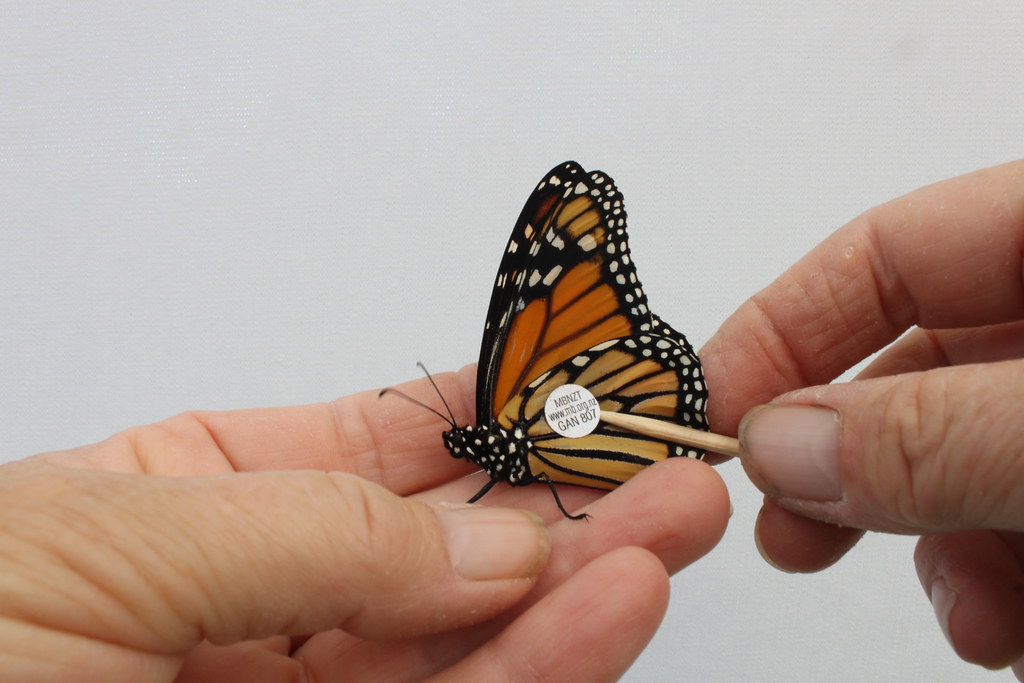
Tagging a Monarch Butterfly (Anna Barnett)
Like birds there are groups of insects who migrate during the day, and others who migrate at night. Diurnal (daytime) migrants seem to use the sun, or if the sun is obscured, polarized light to navigate [3]. Nocturnal (night) migrants navigation is not well studied, but it could be magnetic [4].

There are many methods used to study the migration of insects, from specialized analysis of radar data [5] to applying tiny numbered stickers to butterflies wings on the breeding grounds (during the late summer) and recapturing them on the wintering grounds. By having monarchs tagged all across the country we are able to track Monarchs across North America and understand how populations from different parts of the U.S. move [6].

The most impressive feat of insect migration I've found is the migration of  dragonflies across the Indian Ocean. This round trip flight across the Indian Ocean spans over 14-18 thousand kilometers (8500-11000 miles) [7,8] While assisted by wind, it is still quite impressive. They, like the monarchs take several generations to make their huge journey.

Monarch Butterflies, like many other organisms will start migrating soon. While birds will migrate fairly quickly, just taking a few weeks to make the journey north, butterflies will slowly make their multi-generational way north, moving a few hundred miles and laying the eggs of the next generation. They won't be arriving in the mid latitude states until mid May and the upper Midwest by mid June. If you see Monarchs around your neighborhood this spring, report them here and help us better understand how these remarkable critters are moving across the continent. Spring will get here eventually, so keep your eyes peeled!

~~~~~~~~~~~~~~~~~~~~~~~~~~~~~~~~~~~~~

On a non-migration related note, today I read about hornets and how they defend their hives from other insect invaders by surrounding the invader and vibrating their thoraxes to create so much heat that the intruder DIES! Nature is so cool sometimes.

- Auriel

~~~~~~~~~~~~~~~~~~~~~~~~~~~~~~~~~~~~~
Citations

[1] Denno, R.F. (1994) The evolution of dispersal polymorphism in insects: the influence of habitats, host plants and mates. Researches on Population Ecology 36, 127–135.

[2] http://www.annualreviews.org/doi/pdf/10.1146/annurev.en.33.010188.001151

[3] Hyatt, M. (1993) The use of sky polarization for migratory orientation by monarch butterflies. PhD thesis, University of Pittsburgh, Pittsburgh, Pennsylvania.

[4] Baker, R.R. (1987) Integrated use of moon and magnetic compasses by the heart-and-dart moth, Agrotis exclamationis. Animal Behaviour 35, 94–101.

[5] http://bioscience.oxfordjournals.org/content/53/5/503.short

[6] http://monarchwatch.org/tagmig/fallmap.htm

[7] Anderson, RC (2009). "Do dragonflies migrate across the western Indian Ocean?".Journal of Tropical Ecology 25: 347–348.

[8] http://news.bbc.co.uk/earth/hi/earth_news/newsid_8149000/8149714.stm

Thursday, February 27, 2014

Migration - in all its flavors

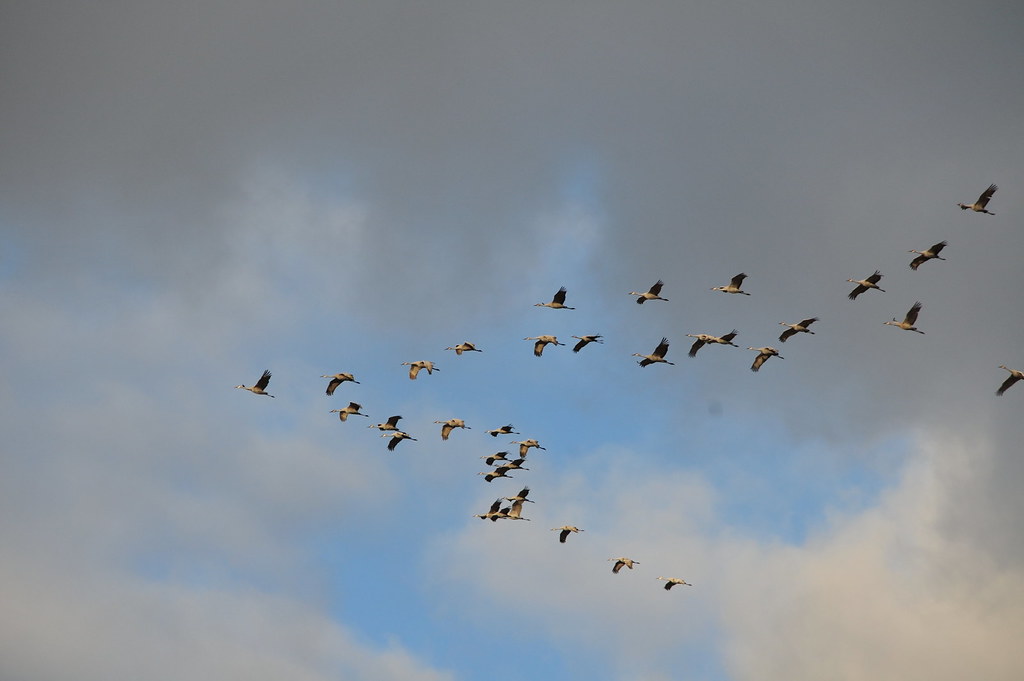
Sandhill Cranes Migrating (Serge Melki)
Migration is one of the wonders of the natural world. Millions of animals move thousands of miles every year in an attempt to produce as many offspring as possible. When most people think of migration they think of Canada geese flying south for the winter and their return in the spring. You might not realize, that while these birds demonstrate impressive feats of migration, there are others kinds of migration in the bird world.

What makes all these things migration is they involve going back and forth between two places. It doesn't matter if its 2000 miles south or 3 miles up a mountain.  No matter the difference, birds are always migrating in some way during the year.

------------------------------------------
'Loop' Migration
------------------------------------------
Loop migration is what you'd normally call migration, where birds arrive in the spring and leave in the fall. Loop migration can be broken down further into a few categories, long distance, medium and short distance migration. All of these are annual movements for the same purpose. Birds migrate to take advantage of seasonally abundant food. In northern latitudes insect populations, fruit and seeds BOOM in a huge way in the summer. Taking advantage of these resources allows birds to produce more young than they would have in the tropics. Northern latitudes also provide an advantage because the tropics have constant competition for resources and higher predation.

Migration is not without it's risks of course but if you reproduce enough it offsets the high risk of dying during migration. In this way, you and the rest of your species can continue into the future, so you win. 

------------------------------------------
Altitudinal Migration
------------------------------------------

Unless you are lucky enough to live in the mountains, birds migrating up and down in elevation is the kind of migration you are probably least familiar with. Many mountain species take advantage of the perks of loop migration without traveling as far. Altitudinal migration presents unique challenges like extreme weather and changes in snow pack.

Altitudinal migration is quite common in tropical areas, where moving up and down in elevation can help mitigate the impacts of the rainy or dry season on food supplies. By moving around the landscape a bird can take advantage of the habitats with the most food and increase their chance of survival. Birds who live on small remote islands also demonstrate altitudinal migration. Instead of migrating several thousand miles to the next land mass they move up and down the mountain throughout the year. They are likely migrating up and down in response to the annual wet/dry cycle on the island.

Altitudinal migration is unique since its not always done just for the purposes of breeding. Some species migrate up in elevation to take advantage of seasonal abundances of insects so they have plenty of energy to molt their new feathers quickly [1]. It is extremely expensive energetically, which means it takes lots of food and energy to accomplish. Birds feathers go through extensive wear in a years time; replacing them is important for keeping the bird the correct temperature and flying efficiently.

------------------------------------------
Irruptive Migration
------------------------------------------

Irruptive migration is an odd kind of migration because it doesn't fit the way most people think of bird movements. Irruptive migration doesn't  happen every year, instead they are normally triggered by an abundance or shortage of  food. When food is scarce in the north birds come south looking for other resources; this is often why crossbills irrupt. When food is abundant, such as a boom of lemmings, birds are able to produce large numbers of offspring. A boom in the lemming population is what we think is going with Snowy Owls this winter. Boone did a post awhile back that covers their irruption in more detail. 


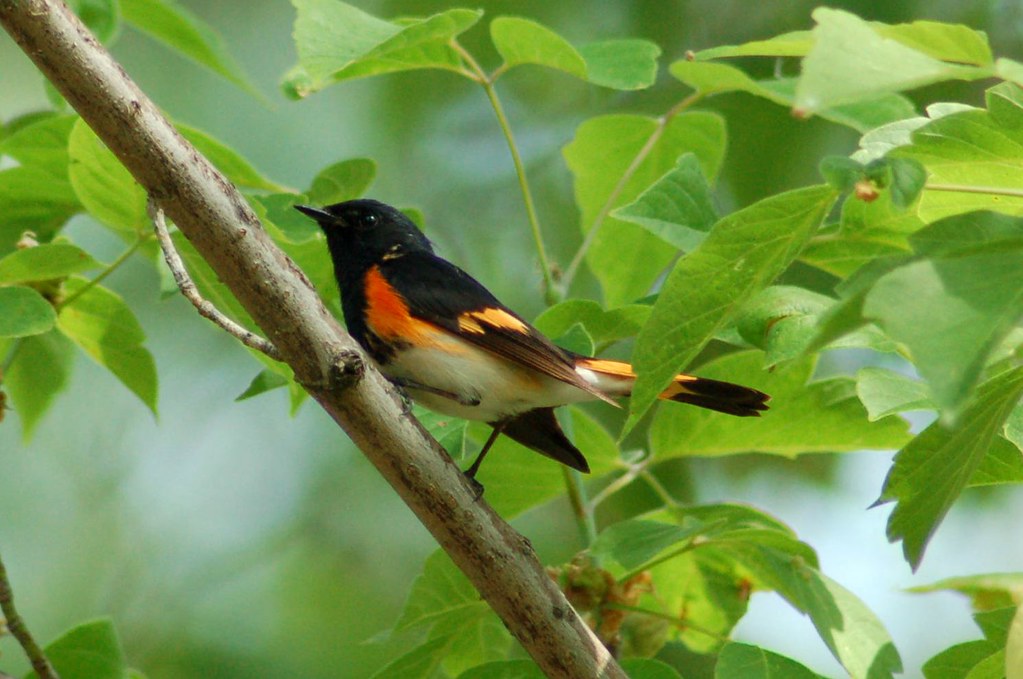
American Redstart (Derek Bakken)
------------------------------------------
Differential Migration
------------------------------------------

Differential migration can happen in every kind of migration. It means a subset of bird populations migrate differently. When males and females migrate separately and winter in different places, or when juvenile birds go south their first year and don't return north for several seasons, they are both demonstrating differential migration.

For example, female Cooper's hawks migrate significantly earlier then males. Arriving earlier may allow them to take advantage of extensive resources and put on weight in preparation for egg laying or to find the best nesting locations [2]. American Redstarts males and females migrate to different areas for the winter [3]. This segregation is caused by behavioral dominance by the older males who set up territories and force other individuals (usually female) into less desirable habitats. The exact reason for most differential migration is still unknown, but understanding the different ways a population migrates help us to better conserve their habitats. 
------------------------------------------

It bears mentioning birds are not the only group of animals who migrate. We'll try and round up a post on those as well here sometime soon. In the meantime, keep on the look out for signs of spring migration near you! SPRING IS COMING!

- Auriel

--------------------------------------------------------------------------------------------

Citations

[1] Rohwer, V. G., S. Rohwer, and J. H. Barry. 2008. Molt scheduling of western Neotropical migrants and up-slope movement of Cassin’s Vireo. Condor 110: 365-370.

[2] Hull, J.M. Pitzer, S., Fish, A.M., Ernest, H.B., and Hull A.C. 2012 Differential Migration in Five Species of Raptors in Central Coastal California. Journal of Raptor Research 46(1):50-56. http://www.bioone.org/doi/abs/10.3356/JRR-10-116.1


[3] Marra, P.P, Homles, R.T. 2001. Consequencces of Dominance-Mediated Habitat Segregation in American Redstarts During the Non-Breeding Season. The Auk. 118(1):92-104. 
http://www.bioone.org/doi/abs/10.1642/0004-8038(2001)118%5B0092:CODMHS%5D2.0.CO%3B2

Thursday, February 20, 2014

Why Migratory Birds Ignore Puxsutawney Phil

I for one am tired of the cold. Don't get me wrong, this winter in Delaware has been great. We've had an abundance of snow and few days of freezing rain, but this Texans had enough. I was raised on a steady diet of 6 months of hot, 2 months of cold, and 4 months that are only kind of hot. By mid February it's time to start buying swimsuits and stocking up on suntan lotion.

Punxsutawney Phil the Perpetrator
  (Alessandro M.)
Unfortunately, I don't live in Texas anymore. Punxsutawney Phil, the infallible weather muse, has predicted six more weeks of winter for the east coast. We'll forget for a second that our rodent friend is less than stellar at prediction and take his words at furry face value.

Just 2 weeks from now, the lucky residents in Texas will herald their first of the season main land migrants, and in 3 weeks every gulf state from Texas to Florida will see their very first migratory species. This may sound early to some of you, and indeed it is, but certain individuals in a population will try to get an early start to their breeding season. These include the southern breeding species like the Golden-cheeked Warbler, southern U.S wintering warblers like the Northern Parula , the early gulf migrant Louisiana Waterthrush, and the seemingly always migrating Purple Martin.


This winter has been brutally cold. We've seen record snowfalls in the south, and the great lakes ice coverage at it's highest extent since 1994 (90%). If this years weather and our furry friends ominous prediction is right, these early birds will be in a heap of trouble. So why would an individual migrate early when its still cold and how do birds cope with the wildly inconsistent weather in spring?

The extent of the ice on the great lakes this year (noaa.gov)
Lets start of first with an easy question:
----------------------------------
Why even show up early?
----------------------------------
Birds benefit from arriving early in a variety of ways. They get the best pick of territories, avoid predators, and have more chances to succeeded. All of this equates to better breeding success (the chance of successfully raising chicks to adulthood).

Males arriving to a breeding site first get the best pick of territories. If these males choose the highest quality habitat, they'll have an easier time feeding their nestlings. This increases not only an individual chicks chance of surviving, but increases the numbers of chicks a pair can raise.

Common predators for nesting songbirds include snakes and raptors (birds of prey). The time of the highest nest predation coincides with the middle of the breeding season. Nesting hawks have to forage more as their own nestlings grow up. This increases predation as the seasons progresses. With the progression of seasons, temperatures heat up, leading to more snake species migrating out of their winter dens. This all culminates in peak nest predation in the middle of the breeding season. Earlier migrants can skip this dangerous phase by nesting earlier before these factors peak.

Most songbirds nest multiple times in a season until they finally succeed. Some crazier birds may even renest after they've succeeded in raising the first nest.  In the case of Willow Flycatchers, some parents begin nesting before the first brood is even able to fly! So, with an early start to the breeding season, you get not only more chances to succeed, but more time to raise even more young!

It's clear, there's a real advantage to showing up as early as you can.
----------------------------------
What could possibly go wrong?
----------------------------------
Well mainly weather.
The top weather-related killer of birds is the cold. Untimely snow storms routinely kill birds who aren't prepared. Particularly wet snow can quickly saturate a birds feathers, forcing it to land freezing and wet. Situations like this kill even hardy snow birds. It's no surprise that species who aren't used to cold temperatures regularly die of exposure when an unseasonal cold front penetrates into the south [1].

Ice can also be particularly tricky for birds. Waterbirds, like ducks, require open water to feed. When all available water is frozen over, many starve before they can find water. Because of this, ducks often fly hundreds of miles south in search of open water in the winter. This permanent relocation leaves many of us in the Northern States (yah I just said that Auriel) with a lack of ducks for the rest of winter.

Surf Scoters, Indian River inlet, DE
Birds who usually experience extreme weather are well adapted to it. It's when temperate birds run into this weather that there becomes a problem. These birds spend the majority of their time in warmer locations and tremendous amounts of energy flying thousands of miles north to breed. These exhausted tropical vacationers are ill suited in maintaining their internal temperatures. In spring, spending a night below 10 degrees Celsius (50F) costs a songbird the same energy as flying for 3 hours. [2]. To a small song bird that's ~90 miles! [3].

----------------------------------
So what keeps them from showing up early?
---------------------------------- 
The range map of Golden-Winged Warblers
Migratory birds react strongly to temperature. The correlation between the average temperature at a migrants wintering grounds and summer grounds is both fascinating and complicated (We'll go indepth on this at a later date). Many studies have shown some species won't migrate north unless it's certain temperature.[2][4] Unseasonably cold temperatures in spring are usually brought about by a cold front from the north. This all but guarantees the northern latitudes are also cold. Migrants can dictate their future weather patterns by monitoring temperatures and delaying their departure till situations improve.

The pattern of migration is generally where southern migrants move through first and northern populations arrive later.  This keeps migrating birds at a manageable latitude, but can lead to highly incongruous breeding seasons. A warbler breeding in the southern Appalachian Mountains in late April has entire month head start over it's twin breeding all the way in Canada in June.


Despite evolutionary traits, some birds still fly straight into bad weather.

Last year, a late arctic blast ran straight through the Midwest. Migrating rails, already on their journey, were faced with frozen wetlands with no where to go. Lucky for them, these hardy wetlands species have adaptations to survive in conditions similar to this. Rail species like the Virginia and Clapper rail are routinely found all the way into Delaware and New Jersey in winter. The northern most breeding rail, the Yellow Rail, breeds just shy of the arctic circle. Their bigger bodies, water resistant feathers, and terrestrial foraging allows them flexibility when it comes to surviving temporarily in variable temperatures.

Two Clapper Rails taking the ice in Delaware raily well
If a birds particular tolerance or adaptations fail, we unfortunately find large scale mortalities.  In March 1904, an estimated 1.5 million birds were found dead buried in the ice and snow after a blizzard in Minnesota. In 1964, 100,000 king eiders died when water ways refroze in the spring. This impact can sometimes be quite extreme on populations. A study populations of cliff swallows in the great plains, lost 54% of their population when unseasonable weather hit the region in 1996 [1].

This extreme consequence acts as a natural checks and balances system for  birds. Nature maintains a hard line that punishes birds that arrive at the wrong time.  Without it, birds would casually move their timing earlier and earlier.

Interestingly, we're actually seeing migratory timings shifting earlier in the spring. Over all global warming trends have lead to earlier plant blooming and migratory bird timing. We're seeing not only earlier migrants but northern range expansions of sub-tropical species into the north. Clearly the cold hasn't stopped them. [5][6].

----------------------------------
Migratory timing is a large field in science, and this article has just touched the tip of the iceberg. We haven't for example mentioned birds being tied to high concentrations of bug activity, or the consequences of freak storms (hurricanes and tornadoes) on migrating birds (my masters research ;)). Clearly there's a lot for us to get to and always more to learn.

If you have any questions or would like to suggest a topic we cover, feel free to email us at naturalausterity@gmail.com

-Boone
_________________________________________________________________________________
[1]Newton, I. (2007). Weather-related mass-mortality events in migrants. Ibis, 149(3), 453–467. doi:10.1111/j.1474-919X.2007.00704.x
[2]Wikelski, M., & Tarlow, E. M. (2003). Costs of migration in free-flying songbirds. Nature, 423(June), 2003.
[3]Alerstam, T., Chapman, J. W., Bäckman, J., Smith, A. D., Karlsson, H., Nilsson, C., … Hill, J. K. (2011). Convergent patterns of long-distance nocturnal migration in noctuid moths and passerine birds. Proceedings. Biological Sciences / The Royal Society, 278(1721), 3074–80. doi:10.1098/rspb.2011.0058
[4]Gauthreaux, S. A. (1991). The Flight Behavior of Migrating Birds in Changing Wind Fields : Radar and Visual Analyses. American Zoologist, 31(1), 187–204.
[5]Gordo, O. (2007). Why are bird migration dates shifting? A review of weather and climate effects on avian migratory phenology. Climate Research, 35, 37–58. doi:10.3354/cr00713
[6]Marra, P. P., Francis, C. M., Mulvihill, R. S., & Moore, F. R. (2005). The influence of climate on the timing and rate of spring bird migration. Oecologia, 142(2), 307–15. doi:10.1007/s00442-004-1725-x


Thursday, February 13, 2014

Common Bird Profile: Northern Mockingbird

Northern Mockingbird (Mike Baird)
Northern Mockingbird (Mimus polyglottos)

I didn't really appreciate Northern Mockingbirds till I lived in Arkansas. I grew up with watching mockingbirds in Ohio but there are so many of them here in Arkansas. They live in all the bushes around my apartment complex and fight constantly. Their beautiful song fills the spring air and their complex mimicry fools even the best birders.

What mockingbirds are known most for is their ability to mimic a wide variety of sounds. Many birders who have been sent on wild goose chases after one species or another only to find out it's a mockingbird.

One of the main reasons birds sing is to attract or maintain a connection to a mate. Some species have elaborate dances, flight displays or vibrant colored plumage to attract mates. Mockingbirds look plain, but they make up for it in their singing ability. Female mockingbirds have been found to choose mates with larger repertoires [1]. Mockingbirds don't only imitate other birds songs, they have also been documented imitating a wide variety of other sounds from their environment. A friend of mine had a mockingbird learn to imitate her alarm clock, much to her annoyance since the mockingbird started singing far earlier then she wanted to wake up each morning.

We still don't know exactly how they learn these songs, but researchers in North Carolina have found mockingbirds learn songs that  are the easiest to mimic and the most similar to the songs they already know [2]. Over time this could lead to a wide range of vocalizations as they gradually expand their repertoire. Mockingbirds often mimic sounds in repeats of three, which can make picking them out as opposed to the actual birds song a bit easier. Why they repeat songs is not well understood. It may be connected to how they learn the songs or have something to do with maintaining the songs in their memory [3].

What we do know is mockingbirds are singing machines which may sing for hours and hours, even all night during the breeding season. Mockingbirds ability to pick up any sound in their environment has caused some problems for scientists studying other species. Mockingbirds in northern California mimic Black Rails. This made it challenging for the scientists who were out surveying for the elusive rails because they had a hard time distinguishing between the mockingbirds and the actual rails [4].

This video is a great example of the repertoire of these birds, see if you can pick out the different species this mockingbird is imitating, and the car alarm about 10 seconds into the video.


Northern Mockingbird (Manjith Mainickara)

While mockingbirds are plain in coloration they are a great example of coloration with a purpose. The color white is rare in nature, except in cases where it's used for camouflage (like in Snowy Owls) white is typically used as a form of communication.

The white tail of the white-tailed deer is a sign of alarm to the deer around it and lets an approaching predator know it has been seen. By letting the predator know it's been spotted it can decide if it wants to pursue a prey item without the element of surprise [5].

Northern mockingbirds have been shown to use the white on their wing patches in a similar way. When they are faced with a predator they 'wing flash' to make themselves appear larger, intimidating the predator and to signal to other mockingbirds that there is a predator nearby [6].

Mockingbirds are a fantastic species to find in your neighborhood. Their fearless behaviors and diverse voices make them fun to watch. So spend a little time now and throughout the spring looking for some mockingbirds as you explore your local area and see if you can discover any unique noises your mockingbirds have learned!

- Auriel

____________________________________________________________________________
[1] Howard, R.D. (1974) The Influence of Sexual Selection and Interspecific Competition on Mockingbird Song (Mimus polyglottos) Evolution 28:3 (428-438) http://www.jstor.org/stable/2407164
[2] Gammon, D.E. (2013) How is model selection determined in a vocal mimic?: Tests of Five hypotheses. Behaviour. 150:12 (1375-1397)
[3] Gammon, D.E., Altizer, C.E. (2011) Northern Mockingbirds produce syntactical patterns of vocal mimicry that reflect taxonomy of imitated species. Journal of Field Ornithology. 82:2 (158-164) http://onlinelibrary.wiley.com/doi/10.1111/j.1557-9263.2011.00318.x/full
[4] Conway, C.J., Gibbs, J.P., 2001. Factors influencing detection probability and the benefits of call broadcast surveys for monitoring marsh birds. Laurel, MD. http://ag.arizona.edu/research/azfwru/NationalMarshBird/downloads/technical_reports/Conway_and_Gibbs_2001_Report.pdf [5] Bildstein, K.L., (1983) Why White-Tailed Deer Flag Their Tails. American Naturalist 121, 709–715. http://www.jstor.org/stable/2460873
[6] Dhondt, A.A., Kemink, K.M. (2008) Wing-flashing in Northern mockingbirds: anti-predator defense? Journal of Ethology. 26:3 (361-365). http://link.springer.com/article/10.1007%2Fs10164-007-0070-z#page-1

Saturday, February 8, 2014

Great Backyard Bird Count

One great thing about ecology and biology is we can use observations of the outdoor world from everyone, not just those with scientific training. These observations can help scientists better understand birds across the country and around the world.
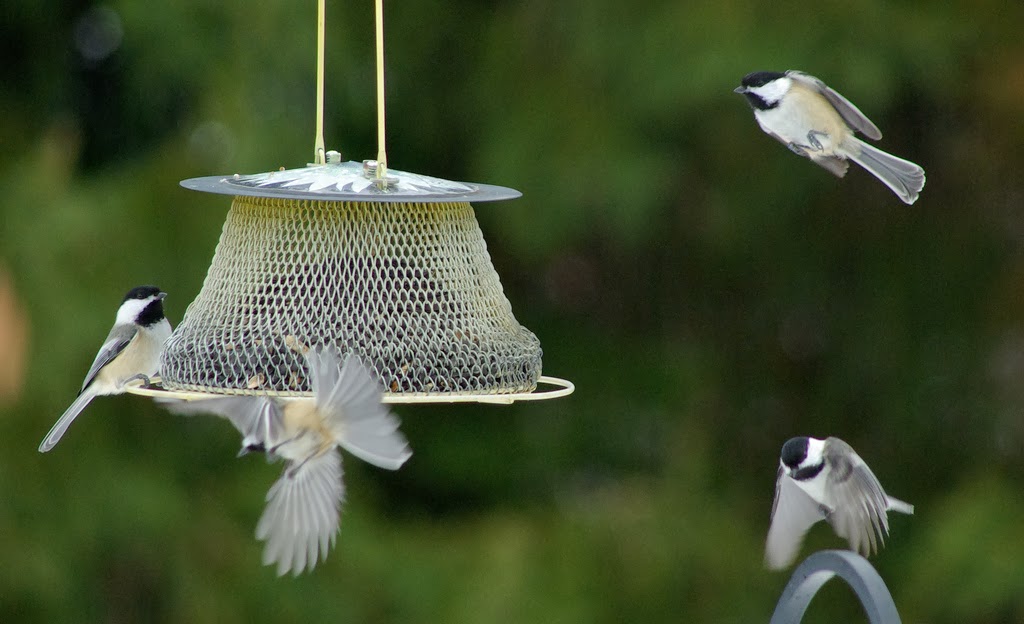
Chickadees at the feeder (Ano Lobb)

One of the ways everyone can contribute to our understanding of birds is by submitting your observations to eBird. Many don't feel their observations of birds in their backyard isn't important but that is not the case! Tracking the patterns of backyard birds can help us better understand the impacts of weather, pollution, urbanization and other forces on all bird species.

Since this backyard bird information is so important the Great Backyard Bird Count (GBBC) was created as an annual four day event to encourage everyone to pay attention to what is in their backyard and submit data so we can compare across big areas and between different years.

The count is done in February before most species start migrating so it will help us understand the distribution of bird species which are residents, or of species like Juncos which may only be around during the winter months.

The 2014 GBBC is February 14-17th and I encourage all of you to spend a few minutes watching the birds out your window, or along your drive/ride to work and submit what you see. It's really interesting to see what people find. Some species, like Northern Cardinals have made big expansions recently, where as others ranges have reduced.

All the GBBC information will be submitted to eBird and participating in the GBBC is a great way to get familiar with the website and maybe start a habit of submitting your sightings more often!


Friday, February 7, 2014

How to Cook in Your Car

You're cheap.

Like barely have enough gas money for this trip, cheap.

Four hours into your weekend warrior adventure, and you're just now realizing you forgot all about eating.

It's ok, we've got you on this one. This is the definitive guide to eating (cheaply) in your car.

Starting off, fast food is definitely the wrong way to go.

If you ate out for 3 meals a day that would cost you at least $15 (and that's being conservative). Multiple that by 7 days and you're already spending $105 on food. That doesn't even include snacks and drinks along the way! We can't be efficient Travelers on a Budget if we keep spending so much money.

They are various ways to save money on food, some are more extreme than others.We'll break them down into 3 categories of extremeness: Amateur, Intermediate, and Advanced.  That way you can choose how crazy you want to go.

-----------------------------
Amateur
-----------------------------
This is the classic example where buying food early rather than for convenience will save you money. If you're the snacking type buy all your goods at the grocery store before your leave. Common cheap snack items include:

-Chexmix (don't be afraid of off brands)
-Granola bars
-Sunflower Seeds
-Trail mix
-Peanut-butter Crackers
-Fruit (you can buy a whole bag of apples or oranges for cheap that lasts you for a week)
-Dried fruit
-Cereal (works double as breakfast and a snack)

One thing to watch out for is the amount you snack on the road. Driving can be boring, and idle snacking leads to not unnecessary eating and spending. Try to keep the snacks to every couple of hours.

If you really like to drink soda, buy a 12 pack beforehand. The $3.00 for 12-12 ounce sodas is a much better deal than $1.50 for every 20 ounce at the gas station.

A well seasoned road warrior and camper always brings water with them. It's a good idea to buy a couple gallon jugs of water before you leave, and then fill them up as you need too. That way you don't waste too much plastic and are more likely to have enough water with you. Its easy to forget to drink enough water while driving. That morning coffee and afternoon soda are only going to make it worse. To incentivize drinking water, I buy powdered Gatorade. For about $4 you can buy enough Gatorade to make gallons of Gatorade. Just use a fraction of what it suggests, and you'll find yourself drinking more water and wanting soda less.

If you're traveling a lot, don't forget to buy ice. Just having a cup of ice with whatever your drinking makes you feel more satisfied and happy. Cutting costs at the expense of comfort can start to put a toll on someone mentally and  emotionally. Little creature comforts, like ice, can help cut that cost.

---------------------------------------------------
Intermediate
---------------------------------------------------
The middle ground is where you strike the balance between saving money and not coming off as crazy. Good ideas are to bring your own food fixings for meals, and make them at rest stops.

We love rest stops. To the savvy traveler they are like mini hotels on the road. You should feel just fine bringing your peanut butter, jelly, and bread to the picnic tables to make lunch. What you may not know is most place are fine with you cooking on a small cooking stove. As long as they're up off the grass and on a surface you're fine. Which means your favorite cooking friend can now be your favorite travel companion!

Some stoves like these coleman are fairly bulky but pack up well
Others like this MSR are great for backpacking
These stoves come in various types including ones that are more compact than others. Once you start using camp stoves a whole world of food opens up. Good items you can mae with minimal effort include:

-Sandwiches
-Soups
-Chilis
-Eggs
-Pasta
-Beans
-Hot dogs
-Mac and Cheese
-Ramen (add a can of veggies for a cheap and easy soup)
-Oatmeal (dress it up with peanut butter, chocolate chips, fruits, nuts, or honey)

As summer approaches we'll be highlighting good traveling recipes, and a section on camp stove.

---------------------------------------------------
Advanced
---------------------------------------------------

Make sure to bring a can opener
This is the hobo level of eating cheap. Here you stop caring about what others think, and even what you feed yourself. Economy and efficiency are key.

Canned foods like tuna and chili don't need to be heated up and don't sacrifice too much in taste. The key I found to eating canned food cold is bringing spices and hot sauce. One quick dab of hot sauce can upgrade any food to a higher pallet. Adding other items like bread add variety and texture to an otherwise boring meal.

Many foods out there just require water, they dont necessarily even need hot water, just luke warm water and enthusiastic mixing. These items are great because they require very little cooking and preparation. These include powdered mashed potatoes, eggs, and basically anything dehydrated

Some items specifically require hot water, which can be hard to get a hold of. For this it's great to buy a cheap mugwarmer. Many of these models will plug into a usb outlet or car port. They're great at maintaining a beverages temperature but vary in their effectiveness of heating up lukewarm water. Plug one in about 30 minutes before you need hot water. Once it's a little painful to stick your finger in it's ready to use. The lower temperature usually require at least twice as long of cook time.

It's good to remember they're not designed for boiling hot water. There's a battle between making something that heats up to a high temperature and being a fire hazard. Don't get too frustrated if it heats up slowly.

Gas stations usually have a special spout on their coffee machines that just dispense hot water. They'll charge you for the cup (~$0.25) but you get steaming hot water for your tea and oatmeal in the morning.

Some items you can make with just a little warm water:

-Ramen (cup of soup)
-Easy Mac
-Oatmeal

---------------------------------------------------
Caffeine
---------------------------------------------------

God put caffeine on this earth for the same reason he made saturday morning cartoons, to force man to wake up early.

Making hot tea in the desert
The problem is most cheap forms of caffeine require hot water. While it would be hard to call tea and coffee 'expensive' the trend in the last 10 years is to charge as much possible for someone else to make it for you. For the travel less worried about this, truck stops usually do a good job providing coffee, and many places will charge you less if you're bringing in your own mug. The larger truck stop are usually so stuffed full of coffee types and creamers you'll feel down right spoiled.

If you're looking for a cheaper way you can make your own coffee and tea. Tea is an especially great traveling item. I would highly suggest switching over to tea while travel. It's cheap and always easy to make.

Unfortunately many of us refuse to switch to tea, so we're stuck trying to make do.

Instant Coffee-

Natural Austerity does not condone the use of instant coffees, except one: Starbucks Via. You pay for the better taste (~12 for a $10), but they're pretty delicious. The way they make it is sort of a secret, but from the description their process is legitimately different from  instant coffee creating a unique taste almost like real coffee. The price per unit (~$.83) is cheaper than a cup of a coffee at a gas station, but only marginally so. But they're indispensable for camping trips!

Make your own-

Wikicommons: Leland
The best way to make your own coffee is with a french press. You mix coffee and water together, wait a couple minutes, and then 'press' it, separating the coffee grounds from the water. The great thing about french presses is you can always add strength by letting it sit in the carafe longer. This is actually one of the better ways to make coffee, the problem is lugging a french press around can get a little annoying. They're usually made of glass and can break easily. REI sells a traveling mug/press. You have to pour it into another container after pressing it, otherwise the ground at the bottom with make the coffee more acidic the longer ti sits.

If you want to make iced coffee, put less grounds in, and let it sit overnight. In the morning, add ice and you've got tasty iced coffee.

**Protip: For easy tea without hot water, put 2 tea bags in a your water bottle and throw it up on the dashboard. It may take an hour, but eventually you'll have sun brewed tea! (Not so ironically this works well in the desert where there's an abundance of heat coming in your windows)**

--------------------------------------------------------
The Numbers
--------------------------------------------------------
So we sacrificed junk food for more miles, what did we really save here?
Lets say in the morning you made instant oatmeal in the morning ($0.30) and drank a cup of tea ($0.50) plus ($0.25) for the hot water to make it.  For lunch you made a peanut butter and jelly sandwich (we'll say that you can make 20 sandwiches for $10 of materials) that's $1 for 2 sandwiches. After lunch you snacked on an apple($0.75) and a granola bar ($0.50). Then for diner you ate a hearty meal of chili ($1.50) and mashed potatoes($1). All together you spent $5.80 the entire day.

Compare that to the $15 you were spending earlier, and you saved ~$9. That's almost 2 days extra worth of food or 100 extra miles!
 --------------------------------------------------------

Thats it for now.
So stock up on food, start driving, and don't forget the coffee!
-Boone

Sunday, February 2, 2014

Why YOU need wetlands

Swan Lake National Wildlife Refuge, Missouri 
The southern shores of Lake Erie are where I fell in love with wetlands. I started exploring them in middle school and was captivated by the endless complexity and their year round beauty. Wetlands are home to unique plants and animals, like American Bitterns who make a song kind of like a milk jug being poured out and wetland plants with aerial roots which help them deal with the suffocating conditions of having their roots underwater 24/7. But beyond the interesting parts of wetlands there are some solid reasons everyone should care about them.

I'm here to tell you there are more reasons then just scientific interests for why YOU should care about wetlands and should be celebrating World Wetlands Day today!

From vernal wetlands who only have water a few weeks a year, to coastal wetlands which gain and lose their water every day with the tides, wetlands come in many shapes and sizes. Each wetland is the result of a specific set of environmental conditions, rain, ground water, soil, topography. But no matter what caused the wetland, they are all important to all of us.

This might seem like a broad generalization but it's true! Wetlands clean our water, protected us from floods, and provide habitat for wildlife including many different species which are commercially harvested and eaten round the world. They are also vital habitat for the wildlife we don't eat, including 1/3 of the threatened and endangered species in the U.S. [1]. 

B.K. Leach Conservation Area, Missouri 
Wetlands are Economically Important 

You might not think about wetlands as a resource for anyone other then wildlife but wetlands protect us and our food every day!

Three-quarters of the northern Gulf of Mexico's fish and other aquatic life depend on Louisiana's wetlands for survival [2]. While many of these species spend their adult lives in the gulf, they rely on wetlands as habitat for breeding and protecting their young. 

New York City found it could avoid spending $3-8 billion on a new water water treatment plant by investing $1.5 billion in the purchase of land around reservoirs in Upstate New York. These wetlands purify the water supply FOR FREE [3]. These wetlands also provide great wildlife habitat and recreational opportunities, so it's a great win-win situation for the city of New York and its wetlands. 

A U. S study of the role of coastal wetlands in reducing the  impacts from hurricanes found they provided storm protection services with an estimated value of $23.3 billion per year. [3] This is HUGE! While flooding is a part of the natural cycle the kinds of floods we often hear about aren't natural ones. Before we had lost so many of our wetlands they would have absorbed these large rain events and gradually released the water, helping to keep our rivers flowing year round.

Wetland Loss

We've lost over 53% of our wetlands in the U.S in the past 300 years and approximately 26% of our wetlands globally (most of those losses being in North American and Europe) [4, 5]. Much of this loss is due to draining for agriculture purposes and conversion into other kinds of human development. Wetland loss is a BIG problem, when wetlands are destroyed they can't serve their ecological roles. They can't absorb flood water or clean it, they can't be habitat for wildlife species, and often what replaces them almost works as an anti-wetland. Parking lots are designed to shed rain as quickly as possible, taking runoff and sediment along with them. Excessive runoff clogs up waterways with rain faster than they are built to handle, which can cause big problems for both the environment and people. These reasons and many more are why it is SO important to protect the wetlands that are still around and make sure that they are as healthy as possible. We don't have that many left so we need them to work overtime.

Ways YOU can help wetlands
Wetlands are awesome! (USFWS Pacific)

-Support local organizations who work to protect wetlands (Land trusts, state and federal agencies, county and city parks and other groups).

-Support legislation to protect wetlands.

-Volunteer and help restore and protect wetlands in your community!

-Recycle and help pick up letter so it doesn't end up in wetlands.

-Most of all, Go out and enjoy wetlands!

Wetlands are a treasure trove just waiting to be explored.

There is something to do every time of the year, whether you have 10 minutes or an entire afternoon new things can be found and explored in your local wetlands. Here's a few seasonal suggestions.

- Go out in the spring and look for the wildflowers and birds, stop by in the evening and listen for the frogs.
- Adventure out in the summer, look for snakes sunning themselves, birds feeding their young.
- Return in the autumn to see the beautiful colors and migrating birds.
- Visit again in the winter to see the beautiful patterns in the ice and to check for any winter visitors.


Needs some help getting started exploring your local wetlands? Check out these great resources.
Murky and Quirky - Appalachian Mountain Club
Wetland Scavenger Hunt - Wisconsin DNR
Walnut Creek - A guide to exploring urban wetlands.


__________________________________________________________________________

[1] http://water.epa.gov/type/wetlands/fish.cfm

[2] http://shreveporttimes.gannettonline.com/gns/wetlands/


[3] http://wwf.panda.org/about_our_earth/about_freshwater/intro/value/

[4] http://www.npwrc.usgs.gov/resource/wetlands/wetloss/findings.htm

[5] http://www.ramsar.org/cda/en/ramsar-news-archives-2002--a-global-overview-of/main/ramsar/1-26-45-87%5E16905_4000_0