As I sit in the terminal of Chicago's O'hare Airport with hours to kill, I almost look like a genius. This is a strange feeling because hours ago I felt like a tremendous idiot. Again, like many times before, luck pulled me out by the skin of my teeth. Just 12 hours ago I was quite the opposite, frantic, no sleep, driving much too far to catch a plane that I've known about for months.
This is not my first time, it probably won't be my last. But lets look at what happened today, and see how we can learn from it.
--------------------------------------
I get cocky sometimes. Well actually its just laziness covered with the veil of cockiness. Three months ago I bought this plane ticket: A trip to northern Minnesota and Wisconsin for some fantastic winter birding. But two days ago, my indecisiveness got the better of me. I was slated to fly out from Fayetteville, AR Thursday 11am. Without doing any traveling calculations, I promised a friend I'd spend Wednesday night with him in Dallas.
'I've got this, it'll be fine', I kept telling myself.
I knew the the times were a little off, but I figured it'd be fine. Most of my plans are various forms of 'winging it', and they always turn out ok. They're sometimes not very pretty, but I make it work.
5pm Wednesday night (18hrs before departure)- I land at my friends house later than I planned and commit myself to spend as much time as I can with him before I go back to Delaware.
11:30pm (~12hrs before departure)- Already groggy, I start to google maps my drive to Fayetteville, and do my infamous tired time math.
'Uh-oh, buddy I gotta go to sleep, like right now', I announce suddenly.
With my fuzzy math I've just realized I've got to get up at 4:00am to drive 5.5 hours to navigate an airport I've never been to.
'It's ok, I can just sleep on the plane' I lie to myself. I know I can't sleep on planes.
4:00am(~7hrs before departure)- I get up groggly, much too early, get to the car, forget my keys in the house, come back. Fail to navigate to the correct airport on my gps. Manage to find the right airport. Punch it in the GPS. And then handily get myself lost in Dallas. With a GPS. I take the 3 different wheels in a multiple highway interchange, before managing to get going in the right direction.
'I should have slept more', I grumble to myself. Three hours before the sun even comes up.
That's when I realize all of that fuzzy math last night was using Dallas toll roads. I'm not taking Dallas toll roads. More fumbling, grumbling, and I'm out of Dallas and one hour later than I expected.
5:00am(~6hrs before departure)-I'm 5 hours away. If literally nothing goes wrong I will make it with just enough time to park, walk from the economy lot to the terminal, check in, get through security, and board the plane. In an airport I've never been too. What a stupid thing to happen. Every gas station, coffee stop, bathroom break I watch 5 minutes tick down.
'I knew better than to not factor in those stops' I chastise myself.
9:30am(1.5hr before departure)- After a very uncomfortable drive watching the google maps ETA ticking up I receive a phone call.
A snowstorm in the midwest has delayed my flight by 2 hours.
And suddenly it's all Ok, I'm saved. I went from late to early. At the ticket counter I reschedule my flights for later times in the day, get on the plane, and land in Chicago only 2 hours later than anticipated.
--------------------------------------
6:30pm- Here I sit now, in the middle of a 6-hour layover in Chicago, feeling the opposite of how I felt 12 hours ago. I'm surrounded by many angry people. This storm coupled with some impressive lake effect snow, has thousands of people in the airport angry. Delayed flights, canceled flights, everyone seems angry. But not me.
Auriel and I's propensity for open end planning lead this rather large climactic event to effect us very little. I called her after I rescheduled the first plane ticket, asking if a 7 hour delay was ok. She was fine with it. We talked about the possibility of being stranded overnight in O'hare (still a possibility), not a big deal.
The Journey is the Adventure applies at every step of the process here. Being a very maleable traveler, spending the night in an airport won't effect me that much. I just keep my expectations muted. Even this is highly comical. Whatelse would I be doing right now? Probably sitting in bed doing the same thing I am now. Except I wouldn't be in Chicago, I'd be the same place I usually am, and probably bored.
Auriel's planning for this trip is really open ended. Birding in winter can be very unpredictable, and as such expectations are more of an unknown than anything else. We can change hotels if we want, we can make it to any part of the trip whenever we need to. We'll just shift plans as the come. Where life dictates we go, we'll go, because that's pretty much the only thing you can do. You need to remember there's always a plan B. It may not be close to what Plan A was, but there is another way.
Murphy's law moves our lives around in tumultuous ways. I think that's why the journey is the adventure works. It makes hurdles into turns, you just have to mute your expectations. Expectations are what every angry passenger in this airport has. No, I'm not saying they should all live like this. Many of them have kids, business to attend to, other peoples lives to deal with. Just something to think about when your planning your next trip.
--------------------------------------
The next lesson to learn is the flip side to this argument. The importance of knowledge and giving yourself plenty of time to deal with the problems that may arise.
My fuzzy night time math has hurt me more than once. Making important decisions while your sleepy tends one towards shaving time too close. This creates the travel stress we're all looking to avoid. The reason many of my trips have worked out, despite the complete lack of planning, is how I didn't have a strong schedule to adhere too.
If you couple that with proper planning, calling ahead, seeing when things open, where things are, and thinking properly about what the real life time costs are, then you'll be winning the travel game.
It's something you probably know you should do, but expect thing to not go as they should. Add extra time to your calculations, and don't allow yourself to cut things too close. The stress is almost never worth it. There is a limit on trying to do too much versus your own happiness. Would you rather do 1,000 things crappily or 1 thing really well? While listing lends itself too doing 1,000 things half-assed, we should normally tend towards the latter.
Trust me, that frantic feeling sucks, but for now it's all landed in the realm of 'manageable'.
--------------------------------------
Update-7:44pm, and I've been delayed again 3 hours. Hopefully I'll make it out of this frozen airport by tonight. I've got some birds to see.
10:50pm-ive been delayed further till 1150 now. Perhaps I should start finding a nice corner?
-Boone
Thursday, January 2, 2014

Tuesday, December 31, 2013
Common Bird Profile : Common Grackle
 |
| Common Grackle - (Matt MacGillivray) |
Grackles can be very loud and often are found in large flocks. Their social nature gives us a great chance to watch them and learn about their fascinating social behavior. They can frequently be found calling, puffed up and marching around. Displaying is their way of communicating both to other grackles and to other species of birds. With a bit of careful observation you can start to pick out individuals and understand their social structure.
Male grackles are the ones doing most of the displaying but females can also be found strutting around with their beaks in the air, especially around limited resources, such as food. Exhibiting dominant behavior doesn't stop at other grackles though, which is why many people don't like grackles.
There are two reasons many people don't like grackles, they are often bullies at bird feeders and they are stereotyped as being heavy nest predators. Grackles can be bullies at the bird feeder, but aggressive behavior is natural, there is no way around this behavior, though if you want to discourage them from taking over your feeders there are a few things you can do. Grackles are large birds. If you can create a space they are simply too large for can help prevent them taking over a feeder. By putting some kind of mesh around the feeder with openings too small for grackles you can exclude them while still allowing other birds to feed. There are some more details on how to build on your own here, or you can buy feeders designed to exclude grackles.
Often your best bet is to leave one feeder available to the grackles. This way they can concentrate on one feeder while allowing other species opportunities to feed at the other. Grackles can be very aggressive and it's easy to anthropomorphize and feel bad for the smaller birds, but competition is a part of life for all species.
 |
| Grackle in flight - (Lostinfog) |
Grackles are often found in large multi species flocks. These flocks are often made up of many species of Icterids (Red-winged Blackbirds, European Starlings, Brown-headed Cowbirds, and others) which at first look the same. The members of the flock may appear the same at first it's a great exercise in looking at shape instead of just color. Check out the shape of their wings, the length and shape of their tails and their relative size.
 |
| Grackles and Starlings in flight (jeffreyw) |
There are many other Icterids that may also be parts of these flocks, but if you can learn to ID these four species at a glance you can quickly pick out the strange ones as well and then focus your attention on those. Watching these large flocks twist and turn through the air can be mesmerizing on it's own but once you start trying to pick out different species it becomes a fun challenge.
Grackles are often under-appreciated birds in the backyard, but their complex social behavior can make them fun to watch . What you learn from them can help you better understand and identify many other species.
Whenever I hear the loud ruckus calls of a flock of grackles it always take me back to spring when I was growing up. I would watch hundreds of grackles display and call in the tall poplar trees in my backyard every morning. Hopefully I've convinced you to take a second look at them. With a little time you might start to like them as well as I do.
_________________________________________________________________________________
(1) Friesen, L.E., Casbourn, G., Martin. V., Mackay, R.J. (2013) Nest Predation in an Anthropogenic Landscape. Wilson Journal of Ornithology 125:3 (562-569)
http://0-www.bioone.org.library.uark.edu/doi/abs/10.1676/12-169.1
Thursday, December 26, 2013
Traveling on a Budget: Why you should never buy a hotel early.
 |
| Where you'd probably stay if the price was cheap enough |
So why would you want to spend more money on a hotel you're just going to be in for 8 hours?
Buying a hotel early nails down where you're going to be at a particular moment, and that's not what you want. Breaking down a vacation into a time line is the fast track to reminding you of why you hated your family vacations as a kid. Just passed by a local festival? Sorry, gotta get to the next state by tonight. Are you tired of driving? Too bad, still have 6 hours to drive.
If you book a hotel at the last minute (literally) you're free to stop when you want. This frees your mind from the stress of travel and switches to enjoying what's around you.
This is one of the important backbones to the Traveling is the Journey lifestyle. You have to free yourself from any possible stressfull and constricting factors. That way, your travel is fluid, and more able to adapt to changing conditions and new information.
--------------------------------------
Priceline
Let me sell you on why you should use Priceline.com instead. Sadly, I don't work for Priceline, it would be a dream if I did (hint hint Priceline).Say we assume a 2.5 star or less hotel prices change very little, we can therefore assume we're guaranteed a certain price. That price is somewhere between $40-$50 for a motel 6 or Super 8. These lower star hotels basically never sell out, and are usually in any respectable town along your way.
Priceline lets you name your own price for a region. If you know you're guaranteed a hotel for $40-50, why not try and see if you can get something cheaper. As you're, of course, adhering to the Journey is the Adventure mantra, you have the power.

Head on over to the Name your own Price section, choose 2.5 or 3 stars, and bid a little less than half the price of the lowest hotel you found earlier. Choose the region that seemed to contain the cheapest hotels and press bid. Most likely your first bid will fail, especially if it's anywhere from $20-25. But thats ok, we're starting at your baseline.

By feeling around like this you can usually hit a good price, if you get within $3-5 of the lowest hotel price you found earlier you can either: 1. Start over in an area near the current one. 2. Give up and just choose that cheap hotel you found earlier. Or 3. Just navigate to the nearest super 8's/motel 6's your find and hope they're cheaper (they're probably the same).
If you start worrying, just remember, it doesn't matter if you never find a hotel on Priceline, there's always plan B and plan C
**Pro-tip: Learn the expensive parts of town and use them as an extra bidding oppurtunity. It doesn't matter that they may be out of your way, you get another bidding chance, and they weren't going to accept you anyway. If they do, it's probably worth the couple extra bucks in gas to stay in a 4 star hotel for the night**
For more data points, check out Biddingfortravel.com. This site is a forum for success stories, sorted by particular cities. Just remember, just because last week someone found a particular price, doesn't mean this week you can get the same one.
I've found some really good deals including a $25 hotel room just a block from the beach in South Padre Island! Not booking a hotel till an hour before can really stress out a person that's not used to a lack of planning. Once you get going and win a couple of bids you'll realize it's a win win for you.
Plus it's incredibly exciting when you do book a great deal.
------------------------------
Well maybe you should buy one early, occasionally...
 |
| Conventions, because you know, maybe you're kind of into that. |
Vegas is an entirely different beast that we'll cover later. So for now, I'll just warn you to stay away from pricelining in vegas.
These tips are mainly for travelers passing through or for a single day where location doesn't matter. If you're main destination is a city and you're spending more than one night it might be beneficial to book early. It goes double if you're infact going to Comic Con, book that early and probably like yesterday.
------------------------------
One last thing. You need to remember most hotels are more expensive on the weekends. To counter this, I try to book a hotel only on the weekdays and switch to cheaper accommodations like camping or sleeping in my car on the weekend. Spacing hotels out like this is a great trick for keeping sanity and stay on budget. We'll discuss the topic in depth in the future.
That's it for now, good luck, and happy bidding!
-Boone
Tuesday, December 24, 2013
Travel Hacks : Federal Land Pass
There are many things you need while traveling that can be bought for cheap with the thought you can just beat them up along the way. But every so often you need to pay more to gain more. This is true of all sorts of equipment, many of which we'll get to later, but definitely includes passes.
 One of those passes is the Federal Lands Pass. The $80 price tag might make you balk but it quickly saves you money, especially if your traveling out west.
What this pass does is it gives you free entrance into any federal property that charges a fee. This includes US Forest Service, National Wildlife Refuges, National Parks, Bureau of Land Management and others. It also gives you a discount on camping at many sites.
At first that might not seem like a big deal, but if you look at the cost of just going to a few parks, it quickly pays for itself. Most national parks charge an entrance fee that covers you (or your vehicle depending on the park) going in and out for seven days. For many parks that fee is $20 if not more. If you plan to be there for a week then thats not a big deal, pretty low cost per day. But lets say you're planning a week in Utah and want to hit all the national parks in that beautiful state.
 |
| Not everyone wants to spend seven days in Death Valley, but it's well worth exploring for at least a few hours. |
This lets you decide to pull into Mount Rushmore for fifteen minutes as you're driving through South Dakota or spend a Saturday afternoon at a historic battlefield near home without having to worry about staying in your budget.
If most of your traveling during the year is going to be east of the Mississippi River getting a federal lands pass might have be the correct choice. There are less national parks in the east and some of them (Pictured Rocks National Lakeshore, Great Smoky Mountains National Park) don't charge entrance fees. There are many national historic sites though, so if you're a history buff or if you live near one of the parks that does charge entrance fees it can still be worth it. It's all about making it easier to decide to go explore somewhere.
Since there are more national parks out west and lots more federally owned land (national forests, national wildlife refuges, etc) having the pass can make travel much simpler since you get to make the fun decisions (where) instead of the hard decisions (how much your willing to spend). You can buy a pass online or at most National Wildlife Refuges and National Parks.
Since there are more national parks out west and lots more federally owned land (national forests, national wildlife refuges, etc) having the pass can make travel much simpler since you get to make the fun decisions (where) instead of the hard decisions (how much your willing to spend). You can buy a pass online or at most National Wildlife Refuges and National Parks.
 |
| State Parks With/Without Entrance Fees Green = With Gray = Free Orange = Depends (Arkansas varies by park, Montana is free to residents) |
All of this comes down to the fact that passes make travel an easy decision, which makes exploring easier. Easier exploring is the ultimate goal so you can spend as much time as possible out enjoying the outdoors.
Thursday, December 19, 2013
Common Bird Profile: Tufted Titmouse
Tufted Titmouse (Baeolophus bicolor)
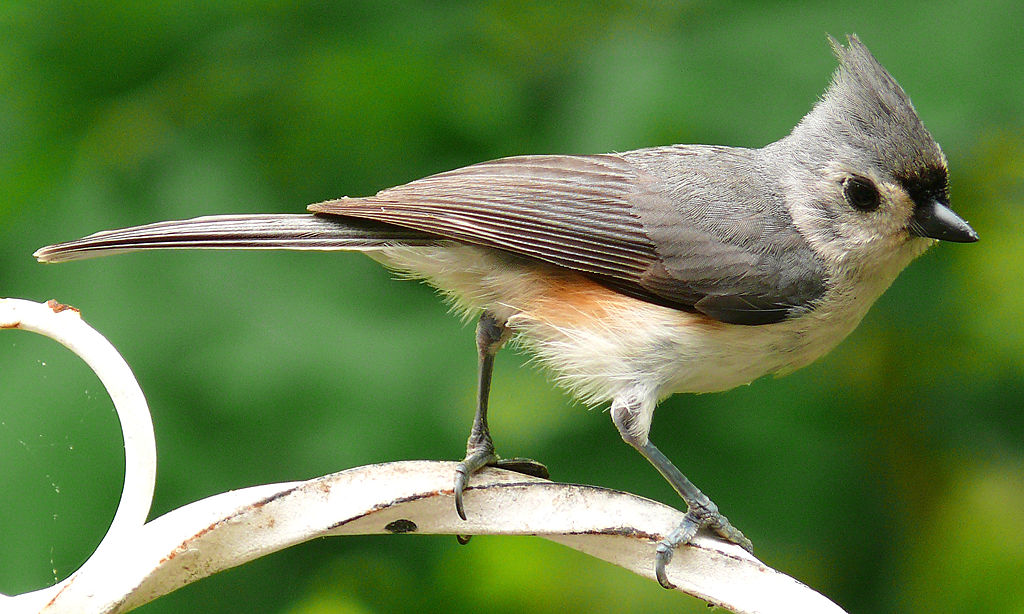 |
| Tufted Titmouse |
Anyone who's birded the eastern forests have come to intimately know this little bird. He's among the first birds you learn to identify as a beginning birder and easy to distinguish once you know what you're looking for. These charismatic and chatty birds are not just a staple but a fascinating bird of behavior.
The Tufted Titmouse maintains small territories and continues to defend them well past breeding season. They're so concentrated in their territory that that few pairs may never leave their homerange. This means your backyard titmice may stay with your for their whole life!
Like blue jays, they are a caching species that store food away for winter. In the fall, you can watch titmice raid bird feeders with what seems like a voracious appetite. Instead of eating the seeds, they'll crack them open on a branch and store them away for later. This can be a problem as they're also known to choose the biggest seeds possible even if that means throwing other bird seed on the ground to get to it. One way to avoid this is to have a bird feeder with just large sunflower seeds, so they can selectively feed there instead.
Charismatic and chatty, titmice are more curious than shy, and will readily come up close to you in response to your approach or sound. They give great looks to anyone around, and like chickadees are useful for birders. You can use their gregarious nature to find other birds any season. During the spring and fall, they are useful in finding mixed species flocks full of migrant warblers and vireos. In the winter, when birds are scarce, you can chase down the sound of a loud titmouse to find other winter birds foraging together. Once you learn their calls you'll realize 50% of the forest bird songs were really just titmice! This will hopefully make identifying other calls much less daunting.
----------------------------------------
The Tufted Titmouse and Black-crested Titmouse
Up until 2002, the related Black-crested Titmouse was considered a subspecies of Tufted Titmouse. This sub-tropical species lives mainly in the warmer and drier parts of Texas and north east Mexico.The two species maintain a hard range along the IH-35 corridor in Texas. This line corresponds not only with the raised elevation of the Balcone's faultline, but the precipitation gradient across the state. The wetter areas of East Texas favor the Tufted, while the semi-arid zones in the Hill Country suite the Black-crested Titmouse. There's even a thin line between the two ranges where both species breed together creating a hybrid that has a completely black-crest and forehead!

 |
| The two ranges of the Tufted Titmouse (purple) and Black-crested Titmouse (green) lining up along the 35in/yr precipitation line (per ebird.org) |
Admittedly, one reason I love the Tufted Titmouse is they remind me of Black-crested Titmice back home in Texas. In the Juniper/Oak forests of central Texas, the juniper is usually less foraged compared to the bountiful oaks. Usually only the resident endemics like the Black-crested Titmouse and Golden-cheeked Warbler regularly forage on them. It's because of this that I always believed they loved Central Texas as much as I do.
Sometimes you don't need a good reason to go birding, just a little reminder of home.
-Boone
Tuesday, December 17, 2013
Advantages of Backyard Bird Feeding Part 2 - Identification
 |
| American Robin - (John Beetham) |
You can identify these species so easily because you are very familiar with the white head of the Bald Eagle, the green iridescence of the Mallard or the rusty orange breast of the American Robin. Being so familiar with the birds around you all the time is one of the advantages of having bird feeders.
The more comfortable you can get with common species, with the changes in appearance they experience throughout the year, what their babies look like, what they look like when their molting the better prepared you'll be to recognize strange things.
 |
| Molting Juvenile Cardinal (Nicole Miller) |
You'll miss the goldfinches changing from their drab winter plumage into their bright summer feathers. Knowing what all these species look like throughout the year helps you identify things quickly and helps picking up on strange things even faster.
If you're used to always seeing House Finches with their red and orange washes on their face covering your feeders and one day you notice one of them is more washed in purple you've probably discovered a new species for your feeder, the Purple Finch. If you aren't paying attention they are easy to miss, but the beautiful raspberry purple color of the Purple Finch is worth the extra effort.
By getting familiar with the sparrows coming to your feeder you'll be better prepared for identifying them and other species when you go out birding. Sparrows can be really tough, they tend to move a lot and don't always give you the best views. Watching them at a feeder is by far the best way to learn how to quickly ID them, its hard to get good looks at them any other way. The faster you can identify the ones you already know the better off you'll be. Whether you become familiar with just the common House Sparrow or if you also have Song Sparrows or Chipping Sparrows at your feeder each one is unique.
Many species of birds are only around seasonally, and paying close attention to the birds at your feeder can help you mark the passing of the seasons. Dark-eyed Juncos are called 'snowbirds' in many places because they show up just before winter and then leave at the first signs of spring. There are dozens of different species that might show up just for the summer, but juncos are snow birds, and their arrival has always been special to me, a bright spot after all the warblers have headed south.
If you like documenting the changing of the seasons try keeping a note book by the window where you see your feeders. Keeping track of when things arrive and depart each year is a great habit to get into and this kind of note taking is really valuable for when you see something strange and you want to be able to document it, either for yourself or to share that record with others.
Watching birds at your feeder can be extremely rewarding and help you better understand your local environment and be better prepared for any future birding adventures. So go fill up the feeders and keep a close eye on who shows ups!
Thursday, December 12, 2013
Traveling on a Budget: The Four Keys
Travel is expensive. There's a multitude of costly variables that bar you from doing it more.
Say you want to go from Austin to San Diego.
First there's a plane ticket, round trip, $350
Then there's a hotel for two nights, $130
You eat out for lunch and dinner your entire stay, $40
That's $520 just to sit in a hotel for two days. We haven't even factored in money for events, transportation, or souvenirs. Your floor is set pretty high, with the barrier for travel that high it may take a whole year just to save up for one vacation.
We need to lower your floor so you can travel farther and more often.
But how?
------------------------------------------
I separate all my costs into 4 variables: Lodging, Entertainment, Food, and Travel. Once I'm looking at all my expenses, I try to figure out how to save in every area. Every dollar saved equals more miles gained.
Lets see how we can apply this to our previous example:
Travel
Instead of flying let's drive. In a compact car with good gas mileage thats only $250 (savings=$100)
Lodging
We're going to find a free place to camp in Cleveland National Forest outside San Diego $0, then use Priceline the next night to book a room in town for only $40 for a total of $40 (savings=$90)
Food
Instead of eating out, we're going to buy all of our food before hand and cook it ourselves at the campsite and in the hotel, $20 (saving =$20)
Altogether the entire trip now costs only $310, saving us $210 total! We could use that money to go whale-watching, eat at a fancy restaurant, or just save it for the next trip.
You can see how each change we make varied in it's overall effect but added up to a sizeable amount.
This segment called Traveling on a Budget will teach you how to save every chance you can, so you can go farther, see more, and spend less. We'll look at various ways to find cheap hotels, calculate whats the most efficient and fastest mode of travel, and learn how to cook food in almost every setting. If you're feeling adventurous, I can even show you why sleeping in your car is the best idea ever!
------------------------------------------
While all these things do sound fantastic, we always need to remember one thing:
You walk a fine line when trying to minimize your costs on vacations. Sometimes saving money can be just as restrictive as showing up to a city with not enough money to do anything. You give up things in one place to gain them in another. You always have to evaluate if that’s alright with you.
It isn't always for everyone. Many times the changes will be light and even enlightening, but others will be drastically different than what you’re used to doing. It’s ok if you don’t feel comfortable, just don’t do it. I see every dollar saved as a mile farther I can travel.
If you were only able to save $15 on your whole trip because you weren’t comfortable sleeping in your car and decided you really wanted some fast food along the way, that’s fine. You just allowed yourself to go roughly 150 miles farther! That’s a meaningful increase in possible opportunities!
So go forth, travel, love, and enjoy.
-Boone
 |
| The only thing to do in San Diego when you're broke |
First there's a plane ticket, round trip, $350
Then there's a hotel for two nights, $130
You eat out for lunch and dinner your entire stay, $40
That's $520 just to sit in a hotel for two days. We haven't even factored in money for events, transportation, or souvenirs. Your floor is set pretty high, with the barrier for travel that high it may take a whole year just to save up for one vacation.
We need to lower your floor so you can travel farther and more often.
But how?
------------------------------------------
I separate all my costs into 4 variables: Lodging, Entertainment, Food, and Travel. Once I'm looking at all my expenses, I try to figure out how to save in every area. Every dollar saved equals more miles gained.
Lodging, Entertainment, Food,
and Travel. (LEFT)
(Auriel, I'm sure is laughing at how cheesy this post
is)
Lets see how we can apply this to our previous example:
 |
| Cheap lodging |
Instead of flying let's drive. In a compact car with good gas mileage thats only $250 (savings=$100)
Lodging
We're going to find a free place to camp in Cleveland National Forest outside San Diego $0, then use Priceline the next night to book a room in town for only $40 for a total of $40 (savings=$90)
Food
Instead of eating out, we're going to buy all of our food before hand and cook it ourselves at the campsite and in the hotel, $20 (saving =$20)
Altogether the entire trip now costs only $310, saving us $210 total! We could use that money to go whale-watching, eat at a fancy restaurant, or just save it for the next trip.
You can see how each change we make varied in it's overall effect but added up to a sizeable amount.
This segment called Traveling on a Budget will teach you how to save every chance you can, so you can go farther, see more, and spend less. We'll look at various ways to find cheap hotels, calculate whats the most efficient and fastest mode of travel, and learn how to cook food in almost every setting. If you're feeling adventurous, I can even show you why sleeping in your car is the best idea ever!
------------------------------------------
While all these things do sound fantastic, we always need to remember one thing:
You walk a fine line when trying to minimize your costs on vacations. Sometimes saving money can be just as restrictive as showing up to a city with not enough money to do anything. You give up things in one place to gain them in another. You always have to evaluate if that’s alright with you.
It isn't always for everyone. Many times the changes will be light and even enlightening, but others will be drastically different than what you’re used to doing. It’s ok if you don’t feel comfortable, just don’t do it. I see every dollar saved as a mile farther I can travel.
If you were only able to save $15 on your whole trip because you weren’t comfortable sleeping in your car and decided you really wanted some fast food along the way, that’s fine. You just allowed yourself to go roughly 150 miles farther! That’s a meaningful increase in possible opportunities!
So go forth, travel, love, and enjoy.
-Boone
Tuesday, December 10, 2013
Advantages of Backyard Bird Feeding Part 1 - Behavior
Bird feeding is the second most popular hobby in the United States, right behind gardening. Watching birds at the feeder can be really fun but is under appreciated by many. What they likely don't realize is watching birds at the feeder can help you better understand bird identification and behavior.
Today we'll tackle behavior.
There are two main kinds of behavior that you can observer, inter and intraspecific. Don't let the oddly similar words (that continue to confuse me) worry you. The meaning behind them is simple..
Interspecific competition is where individual birds of different species compete
Intraspecific competition is where individual birds of the same species compete.
So same species, or different species.
Like when a Blue Jay flies in and scares off the other birds. That is interspecific communication between that Blue Jay and those other individuals. The Blue Jay competing with those other individuals and influencing their behavior.
I spent a lot of time growing up watching Common Grackles interact in my backyard. These birds, which are found in large flocks across a lot of the eastern and central U.S., are scorned by many. If you can get past the noise they really are comical to watch. They spend a lot of time throwing their heads up and trying to intimidate each other. They call, puff up, and show off. If you watch them long enough you can start to see the social structure, who is above who on the social scale.
You can see similar behavior in many species of birds from Brown-headed Cowbirds to Blue Jays and sparrows.
This kind of competition can be really easy to observe, especially between birds of drastically different size or disposition (aggressive Blue Jays versus passive sparrows). Watching the behavior of birds of the same species takes more careful observation. Despite these challenges it can be very interesting.
Having a bird feeder makes this a lot easier since food is one of the big things that birds compete over. Watch and see which birds spend most of their time feeding, which sit above each other on the feeder, or which chase each other off. The birds that win these interactions are often more dominant, or may be making a move up the social ladder.
Today we'll tackle behavior.
There are two main kinds of behavior that you can observer, inter and intraspecific. Don't let the oddly similar words (that continue to confuse me) worry you. The meaning behind them is simple..
Interspecific competition is where individual birds of different species compete
Intraspecific competition is where individual birds of the same species compete.
So same species, or different species.
Like when a Blue Jay flies in and scares off the other birds. That is interspecific communication between that Blue Jay and those other individuals. The Blue Jay competing with those other individuals and influencing their behavior.
 |
| Boat-Tailed Grackles posturing in South Carolina (Ron Cogswell) |
You can see similar behavior in many species of birds from Brown-headed Cowbirds to Blue Jays and sparrows.
This kind of competition can be really easy to observe, especially between birds of drastically different size or disposition (aggressive Blue Jays versus passive sparrows). Watching the behavior of birds of the same species takes more careful observation. Despite these challenges it can be very interesting.
Many species of birds live in flocks and have complex social structures which dictate who can eat when and with whom. If you watch a flock long enough you can start to identify individuals and understand how they all interact.
Having a bird feeder makes this a lot easier since food is one of the big things that birds compete over. Watch and see which birds spend most of their time feeding, which sit above each other on the feeder, or which chase each other off. The birds that win these interactions are often more dominant, or may be making a move up the social ladder.
If you don't have the space for a bird feeder of your own many parks and nature centers have feeders you can watch as well, either in person, or via web cam. (Check out this great South Texas webcam at Sabal Palms!) Its a good way to meet other birders as well!
Thursday, December 5, 2013
Snowy Owl Irruptions
 |
| My Snowy Owl this Thanksgiving. (Delaware Beach State Park) |
But what exactly is going on and what can we expect for the future?
---------------------------
First things first, what is an irruption?
An irruption refers to an erratic movement of a particular species/group outside of it's normal range. In the bird world these are generally focused on finches and owls in winter. What causes an irruption can vary based on the species. Finches irrupt as they move south in search of food, this usually happens when fall seed production from coniferous trees turns out lower than expected. This can be due to bad weather in the spring and drought.
Finch irruptions are regularly forecasted by Ontario Field Ornithologist Ron Pittaway. He publishes an excellent report every year on conifer seed production and the expected irruption for finches. Common irruptive finch species include Red Crossbills, Evening Grosbeaks, Pine Grosbeaks, and Purple Finches
Owls will irrupt following a good productivity year in spring. When food abundance is high, owls will hatch higher amounts of owlets. Some pairs will forgo breeding all together! Conversely, a lack of food on the breeding grounds can force an irruption in winter. As temperatures begin to fall starving owls are forced southward to find food.
Snowy Owl's are the main owl prone to irruptions. This species boreal lifestyle depends primarily on the population of lemmings in the arctic. As a result, they irrupt depending mainly on the timing and population of lemmings.
Our last major Snowy Owl irruption occurred in the winter of 2011-2012. Snowy owls were seen all the way from Georgia, Texas, and even Hawaii! While this turned into the biggest irruption in many years, it pales in comparison to some reports from the last 100 years.
(You can read more about the 2011-12 irruption as well as the historical reports here)
-----------------------------
What about this year? How does it compare and what can we look forward to?
We have just begun in this current years irruption. One week ago (Nov 23-24), a few Snowy Owls had been reported from New Jersey, Massachusetts, and Maryland, but quickly disappeared the following days. This weekend (Nov 29-Dec 1) birders out on their annual Thanksgiving weekend birding trips witnessed the bloom as dozens of reports came in from Ohio, to Delaware, and all the way down in North Carolina. Currently as I sit here writing this (December 1st) there are even reports all the way in southern Illinois and Bermuda! Clearly they're moving south.
Lets look at how this irruption compares to the one in 2011-2012:
 |
| Ebird Snowy Owl reports from the early winter months in 2011 (Oct-Nov) |
This year looks a little different:
 |
| Ebird Snowy Owl reports for this current winter (Oct-Dec 5) |
As we're just beginning this great year for Snowy Owl's we can look ahead at whats to come:
 |
| Ebird Snowy Owl reports from 2011-2012 during the entire winter (Oct-Feb) |
As far as this year is concerned it seems the irruption is centered around the eastern United States, with the Great Lakes regions reporting the highest numbers in the US. If this irruption continues through the winter, I'd expect birds to follow the east coast and Mississippi river southward, hopefully overshooting the Ozarks into the great plains.
We'll see how it turns out, but regardless it's already been a lot of fun.
-------------------------------
So we know they could be showing up anywhere this year, but where should we look?
 |
| Two Snowy's perching on the sand dunes in Delaware |
That's all for now! Bird safe and don't harass the owls!
And if you see one don't forget to report it on Ebird and your local bird forum. Scientists and birders alike will thank you!
-Boone
Tuesday, December 3, 2013
How to start exploring locally
So I've made the argument that you should go out and get to know your local area. So how do you start?
 |
| Pull up your local area and look for green space! |
Finding a local nature center, or visitors center for a park can be a huge resource as well. The people that work there will know the best places and can help you know what to expect to see. How do you find these centers?
Pull up your search engine of choice and type in [your state] state parks, or [your county] county parks, or [your city] city parks. Then find something near you.
There are a few things that are good to figure out before you go.
 |
| Sunset at Lake Fayetteville, Fall 2012 |
~ Is there a fee involved?
~ What is there to do there? Is there a lake, a trail, a nature center? Figure out what you want to do but remember that exploring natural places doesn't require an agenda. Just spend some time exploring and see what you can find.
~ How long do you want to be out for? Make sure to bring along some water and maybe a snack. Check the weather, and dress for it. Theres no faster way to have a miserable afternoon then not dressing for the weather.
Once you have that information in hand DO IT!
Take an afternoon or a Saturday and go out and explore. Pay attention to what you see and hear. Do you see any animals that are new? Any cool birds? Are there lots of other people at the park? Sometimes its nice to find a place without tons of people when you just want to enjoy the outdoors without so many distractions. What is everyone doing, does any of it look like something you'd like to try? Thats how I discovered Disc Golf for the first time.
Take an afternoon or a Saturday and go out and explore. Pay attention to what you see and hear. Do you see any animals that are new? Any cool birds? Are there lots of other people at the park? Sometimes its nice to find a place without tons of people when you just want to enjoy the outdoors without so many distractions. What is everyone doing, does any of it look like something you'd like to try? Thats how I discovered Disc Golf for the first time.
The most important part is to get out there and explore, get comfortable checking out a new place and learn a bit about where you live.
Subscribe to:
Posts (Atom)